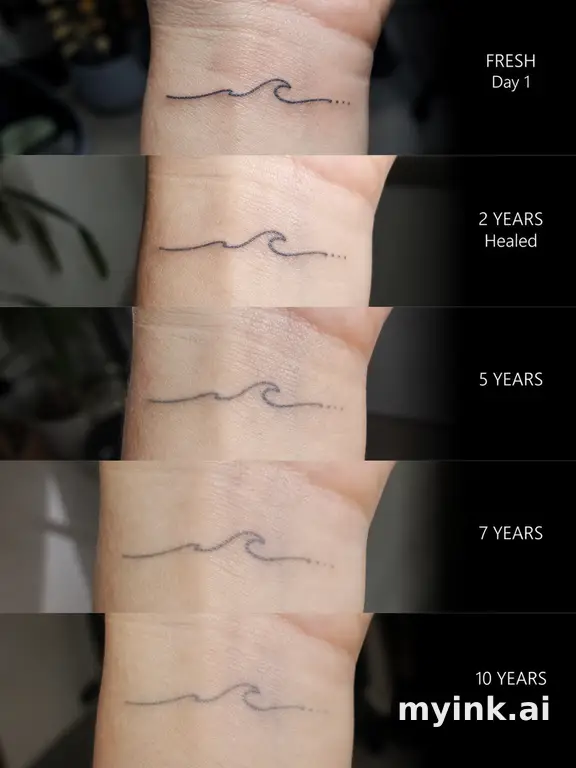
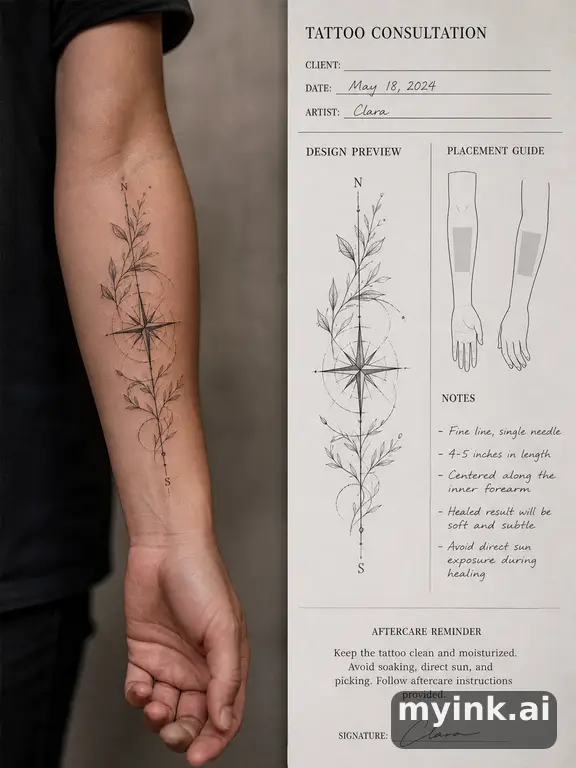
a tattoo aging comparison for a minimalist wrist design over ten years, in realistic tattoo style, photo-realistic, detailed shading, three-dimensional depth, professional tattoo photography
Realistic tattoo designs aim to reproduce the world with photographic or painterly accuracy on skin — capturing the depth of a portrait's gaze, the texture of animal fur, the luminosity of a flower in full bloom. The realism style demands the highest technical skill of any tattoo genre, requiring mastery of light and shadow, color theory, skin tone gradation, and the anatomical differences between skin and canvas. At its best, a realistic tattoo creates genuine visual wonder — viewers often need to reach out and touch the skin to confirm they are looking at ink rather than a photograph. The style encompasses black-and-gray realism, which uses only black ink diluted to various gray tones, and color realism, which employs the full pigment spectrum to render subjects with painterly depth. Portrait tattoos of loved ones, pets, celebrities, and historical figures are among the most frequently requested realistic designs. Nature subjects — roses, big cats, owls, eagles — also translate powerfully into realistic style. Use the MyInk AI generator to preview realistic concept compositions before your consultation.
Browse designs in this style, then jump into the generator when you are ready.
a tattoo aging comparison for a minimalist wrist design over ten years, in realistic tattoo style, photo-realistic, detailed shading, three-dimensional depth, professional tattoo photography
a cross, in realistic tattoo style, photo-realistic, detailed shading, three-dimensional depth, professional tattoo photography
the phrase 'Carpe Diem' in vintage lettering, in realistic tattoo style, photo-realistic, detailed shading, three-dimensional depth, professional tattoo photography
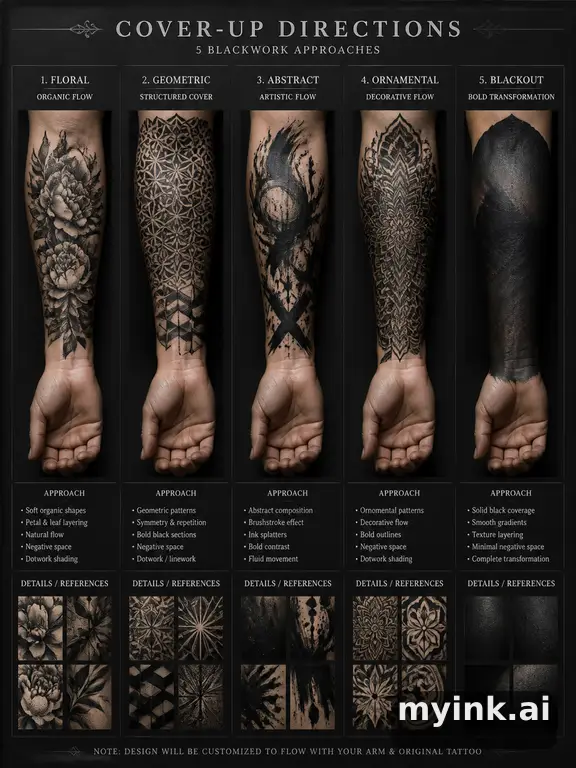
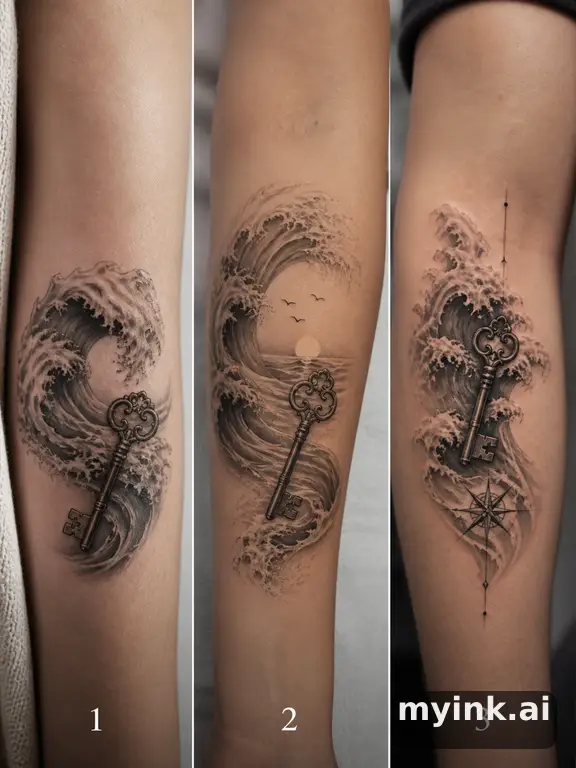
a cover-up tattoo planning board showing five blackwork directions, in realistic tattoo style, photo-realistic, detailed shading, three-dimensional depth, professional tattoo photography
a meaningful vow tattoo concept with subtle symbols and aging-safe spacing, in realistic tattoo style, photo-realistic, detailed shading, three-dimensional depth, professional tattoo photography
a forest treeline, in realistic tattoo style, photo-realistic, detailed shading, three-dimensional depth, professional tattoo photography
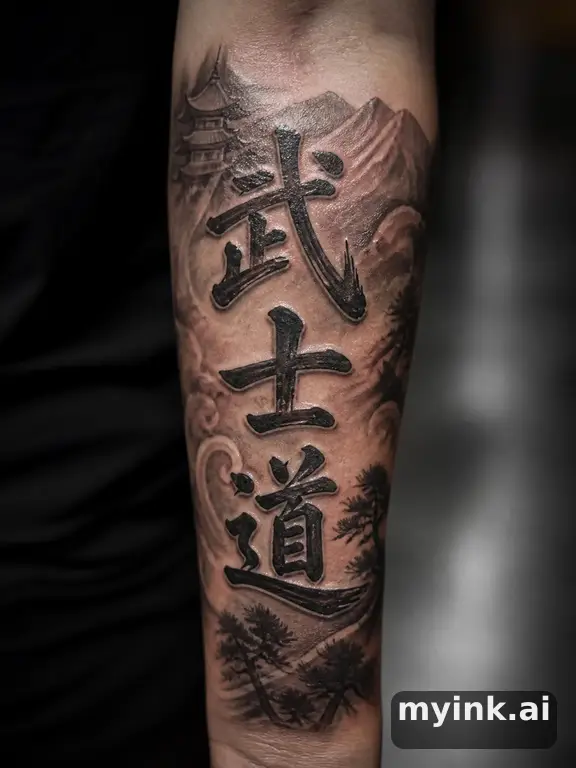
the Japanese kanji '光' (light), in realistic tattoo style, photo-realistic, detailed shading, three-dimensional depth, professional tattoo photography
a peony flower, in realistic tattoo style, photo-realistic, detailed shading, three-dimensional depth, professional tattoo photography
Realism in tattooing developed over decades as technical equipment improved and artists with fine-art training entered the industry in greater numbers.
Attempts at realistic portraiture in tattooing stretch back to the late 19th century, when artists tried to capture likeness with limited equipment and basic ink formulations. These early portraits were crude by modern standards but established the idea that tattooing could aspire to representational accuracy. Military memorial tattoos of fallen comrades were early patrons of realistic portrait work.
The Chicano tattooing tradition of Southern California, particularly in Los Angeles, developed black-and-gray realism during the 1970s in prison environments where artists worked with limited materials — guitar strings for needles, charcoal and pen ink for pigment. The constraint of a single black pigment forced extraordinary refinement of tonal gradation skill that became a distinctive Chicano aesthetic still practiced today.
Color realism advanced dramatically in the 1990s and 2000s as improved pigment formulations offered artists a full painter's palette in stable, skin-safe form. Artists began achieving genuinely photorealistic results — hyper-detailed animal portraits, convincing rose studies, and celebrity portraits that fooled viewers in photographs. Carlos Torres and Nikko Hurtado became defining figures in color realism.
Contemporary realism tattooing benefits from digital photography as reference material — artists can work from high-resolution source images, print reference sheets at precise scale, and sometimes project imagery directly onto skin for preliminary sketching. This access to perfect reference elevates the possible standard of work while also raising client expectations accordingly.
Realistic tattooing has specific technical requirements that differentiate it from all other styles and make expert artist selection especially critical.
The central technical challenge of realism tattooing is convincingly rendering three-dimensional form on a two-dimensional surface using only tonal variation. The artist must define a consistent light source and build the composition's entire value structure — deep shadows, midtones, highlights — around it. Any inconsistency in the light logic breaks the illusion immediately for a trained eye.
Portrait tattoos of people — whether loved ones, celebrities, or historical figures — are the highest-demand and highest-risk realistic tattoo requests. Capturing recognizable likeness requires accurate proportional drawing, precise tonal rendering of skin, and faithful reproduction of characteristic features. A portrait tattoo that misses the likeness is one of tattooing's most common and heartbreaking failures.
Animal portraits — particularly big cats, wolves, eagles, and domestic pets — translate exceptionally well into realistic style because fur, feathers, and scales provide inherently rich textural detail that showcases the artist's rendering skills. Fine, directional hair strokes built up in layers to create convincing fur texture are a hallmark of skilled animal realism tattooers.
Color realism offers maximum visual impact but requires exceptional color mixing skill and pigments that perform consistently under skin. Black-and-gray realism restricts the palette to a single ink diluted to various tonal densities, demanding equally high skill but offering superior longevity — black ink fades at a much slower rate than colored pigments, making black-and-gray realism a practical choice for those prioritizing long-term quality.
Realistic tattooing requires generous canvas space and flat, stable skin surfaces — these constraints significantly limit viable placement options.
The outer forearm and upper arm offer flat, relatively stable skin well suited to realism's fine detail requirements. Medium-format realistic compositions — a single portrait, an animal head study, or a detailed botanical — scale naturally to these areas. The forearm's visibility also makes it a popular choice for subjects the owner wants to see and share regularly.
The thigh offers the largest flat canvas available on the human body for a single realistic composition. Large animal portraits, detailed full roses, or elaborate nature scenes with background environments require the thigh's generous space to develop fully. The outer thigh is lower in pain than the inner thigh or any area near the hip bone.
The upper back — particularly the shoulder blade area — provides a stable, relatively flat surface ideal for large realistic centerpieces. A detailed eagle in flight, a wolf portrait, or a botanical composition with background elements can develop fully in this space. The upper back heals well and the flat surface maintains detail fidelity during the healing process.
Realism tattooing loses impact rapidly on highly curved surfaces like the bicep's inner curve, the knee, or the ankle, where the design warps visually when the limb is in normal position. Curved surfaces also stretch and compress as the body moves, which can affect how the finished tattoo heals and holds detail. Experienced realism artists steer clients firmly toward flatter placements.
Explore photorealistic dragon tattoos with detailed scale texture and dramatic shading.
Discover realistic rose tattoos with lifelike petal shading and dewdrop detail.
Browse realistic animal portraits and nature scenes popular with male collectors.
AAD guidance on safe tattooing practices including the importance of sterile conditions and proper aftercare for detailed tattoo work.
Medical overview of potential tattoo complications, infection signs, and how to ensure a safe experience with any large or detailed tattoo.
Encyclopedic overview of tattooing history and technique, including sections on realism and photorealistic tattooing's development.
Use our AI generator to create custom designs in seconds. Preview, customize, and download — completely free.
MyInk is most useful when the output is treated as a planning reference, not a finished tattoo appointment file. Start with the idea you want to test, choose a style that has a real tattoo tradition behind it, then review whether the design can survive on skin at the size and placement you have in mind.
A strong tattoo preview should have one clear subject, readable contrast, and enough negative space for the design to age. Tiny lettering, hairline detail, crowded symbols, soft watercolor edges, and low-contrast color combinations can look beautiful on screen while becoming hard to read after healing and years of sun exposure.
Placement changes the design. A forearm can carry vertical compositions and readable symbols. Ribs and chest placements need more attention to pain, breathing movement, and body curvature. Fingers, hands, and wrists fade faster because the skin moves, washes, and rubs more often. The preview should help you see those tradeoffs before you pay a deposit.
Use the generator to create directions, then narrow to one or two realistic options. Save the prompt, style, placement, and reference image. That record gives your artist a clearer starting point than a folder of unrelated screenshots and helps prevent last-minute design confusion at the consultation.
An artist still needs to redraw, resize, and adapt the concept. Tattooing is not the same as printing an image on skin. Line weight, stencil clarity, needle grouping, skin tone, body movement, and healing all affect the final result. Treat any AI image as a brief for discussion, not a file to copy without judgment.
Be especially careful with memorial, cultural, religious, medical, or partner-name tattoo ideas. Those designs carry meaning beyond aesthetics, so the right workflow includes a pause: check the spelling, symbolism, cultural context, and long-term emotional fit before turning a preview into a permanent mark.
If a page only gives you a pretty image, it has not answered the important question. A useful tattoo planning page should explain who the idea suits, where it works, what might age poorly, what to ask an artist, and when a safer variation would be smarter.
Before booking, compare the design at phone size, full screen, and roughly the real size on your body. If the main shape disappears when small, simplify it. If the design relies on fragile detail, make it larger or choose a bolder style. If the meaning feels unclear, revise the concept before you involve an artist.
Early tattoo ideation, style comparison, placement preview, cover-up exploration, memorial concept drafting, and preparing a clearer brief for an artist.
Copying another artist's work, replacing professional stencil preparation, guessing cultural meaning, or choosing a permanent tattoo from a single unreviewed image.
Check meaning, size, placement, contrast, aging risk, spelling, artist feasibility, and whether the design still feels right after a short waiting period.
Decide the role of the tattoo first. A decorative piece can be judged by visual strength, fit, and longevity. A memorial or symbolic piece needs a second layer of review: spelling, dates, cultural meaning, emotional timing, and whether the symbol will still feel right when the current life moment has changed.
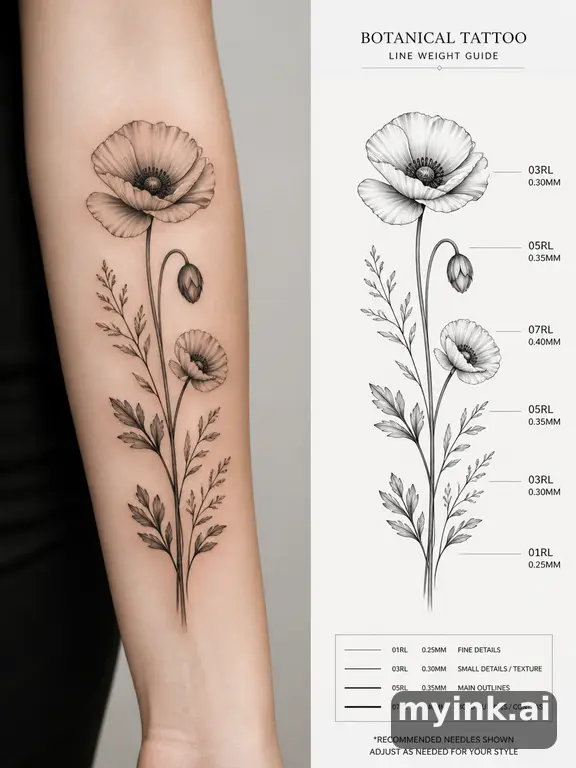
Check the design at real size. A beautiful full-screen image can fail when reduced to a three-inch wrist tattoo. If the subject, lettering, or secondary symbols become hard to read at actual size, the concept needs fewer details, heavier line weight, more open spacing, or a larger placement.
Compare the style with the body area. Traditional, blackwork, and neo-traditional designs usually tolerate aging better because they use stronger outlines and contrast. Fine-line, watercolor, and tiny geometric pieces can be excellent, but they need careful artist selection, realistic sizing, and acceptance that touch-ups may be part of ownership.
If you are planning a cover-up, be even more conservative. A cover-up has to solve the old tattoo's darkness, shape, and location before it can become a new design. The AI preview can help explore directions, but a cover-up artist must judge what is possible on the existing skin.
Use try-on previews to test placement honestly. Rotate, scale, and compare the idea on the intended body part. A design that looks balanced on a flat screen may distort around elbows, ribs, wrists, shoulders, knees, or fingers. The goal is not a perfect simulation; the goal is catching obvious placement mistakes early.
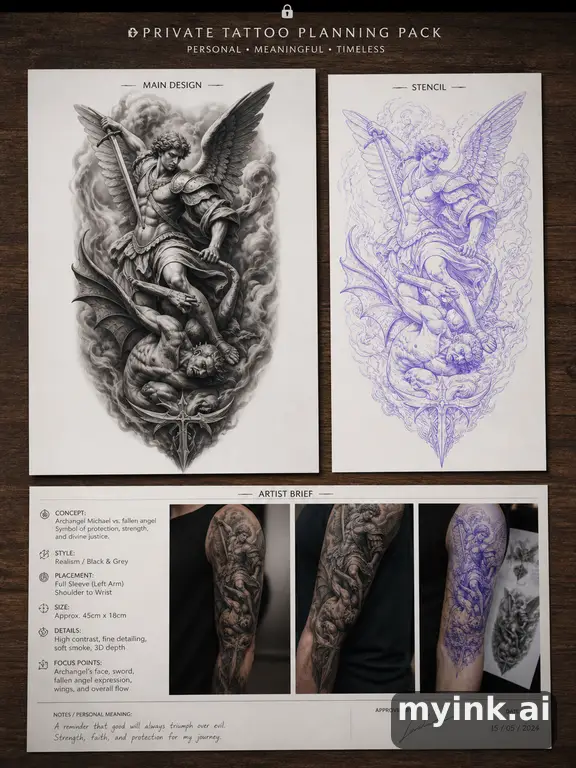
Before sending anything to an artist, write a short brief: subject, style, placement, approximate size, meaning, colors to use or avoid, and any symbols that must stay out. Add one or two generated references, not twenty. A tight brief gives the artist space to create original work while preserving your intent.
Avoid treating a generated image as proof that a tattoo is safe, culturally appropriate, or technically ready. Ask a professional about stencil clarity, line weight, skin tone, placement movement, and healing. The better the AI-assisted planning, the easier that expert conversation becomes.
If the design still feels right after a short waiting period, the next step is a real consultation. If it stops feeling right, that is a useful result too. The safest tattoo planning workflow helps you avoid weak ideas as much as it helps you find strong ones.
A useful preview answers a specific decision question. On an aging page, the question is whether contrast and line weight will survive. On a meaning page, the question is whether the symbol says the right thing without becoming too crowded. On a cover-up page, the question is whether the new design can realistically hide the old shape. On a pack page, the question is whether the concept is ready for an artist handoff.
The best pages therefore combine image exploration with judgment. They explain what the design is good for, where it may fail, what to ask an artist, and which details should be simplified before the tattoo becomes permanent. This is the difference between browsing tattoo images and actually preparing for a safer appointment.
If the output feels close, do not keep generating randomly. Change one variable at a time: style, placement, size, subject, color, or amount of detail. Comparing focused variations helps you see which part of the idea is strong and which part is creating risk.
A tattoo preview should also make refusal easier. If the design looks wrong on the body, feels too tied to a temporary emotion, depends on detail that will not age, or needs a placement you are not comfortable wearing, stop there. Avoiding the wrong tattoo is a successful planning outcome.
Pack and sample pages should be judged by handoff quality. A useful pack explains the concept, shows the intended style, gives the artist enough context, and leaves room for the artist to redraw instead of forcing a copied AI image. If the handoff would confuse a professional, the design is not ready yet.
Guide pages should help with the questions that sit around the image: what to prepare before a first tattoo, how to think about aftercare, when numbing cream needs artist approval, and how to avoid using pain or urgency as the only decision filter.
Sample pack pages should be especially concrete. They need to show what the buyer receives, how the files support an appointment, what still needs artist review, and when a user should keep refining before purchasing a handoff pack.
When a page helps someone ask a better question before the needle touches skin, it has done real work for both searchers and future clients.
That is why the planning pages emphasize clear briefs, readable designs, realistic sizing, and artist review instead of treating image generation as the final step.
If a sample cannot explain that handoff clearly, it should be revised before purchase.
Clear handoffs reduce appointment friction.
They also reduce revision waste later.