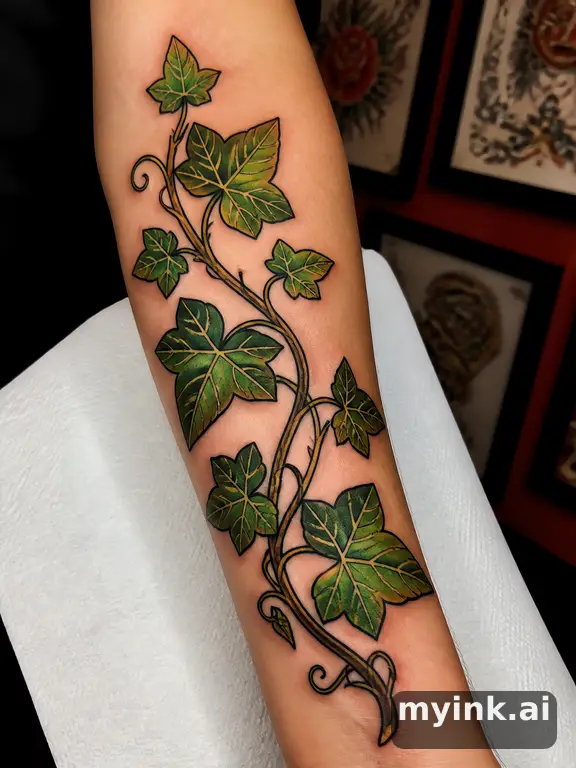
Vine with leaves — Neotraditional Tattoo Design
a vine with leaves, in neo-traditional tattoo style, bold outlines with detailed fills, vibrant colors, illustrative, professional tattoo photography
Neo traditional tattoo designs take the bold outlines and iconic visual structure of American Traditional tattooing and expand them dramatically — adding a richer color palette, more dimensional shading, Art Nouveau-inspired decorative elements, and a wider range of subjects while retaining the graphic strength that makes traditional tattooing age so well. The style bridges the gap between old-school flash aesthetics and contemporary fine-art tattooing, appealing to collectors who want the visual longevity of traditional work without its strict iconographic limitations. A neo traditional rose can have atmospheric gradient shading, jeweled decoration, or realistic petal texture while still carrying the bold outline that defines the style family. Animals, portraits, geometric frames, and botanical elements all translate beautifully into neo traditional interpretation. The style is particularly associated with artists who bring illustration backgrounds to tattooing, resulting in work that references Art Nouveau, graphic novel aesthetics, and decorative arts simultaneously. Use the MyInk AI generator to explore neo traditional compositions and color palettes before committing to your design.
Open the studio with Neo-Traditional pre-selected, describe what it means to you, and generate a 4-image design set.
Open the Studio →Browse designs in this style, then jump into the generator when you are ready.
a vine with leaves, in neo-traditional tattoo style, bold outlines with detailed fills, vibrant colors, illustrative, professional tattoo photography
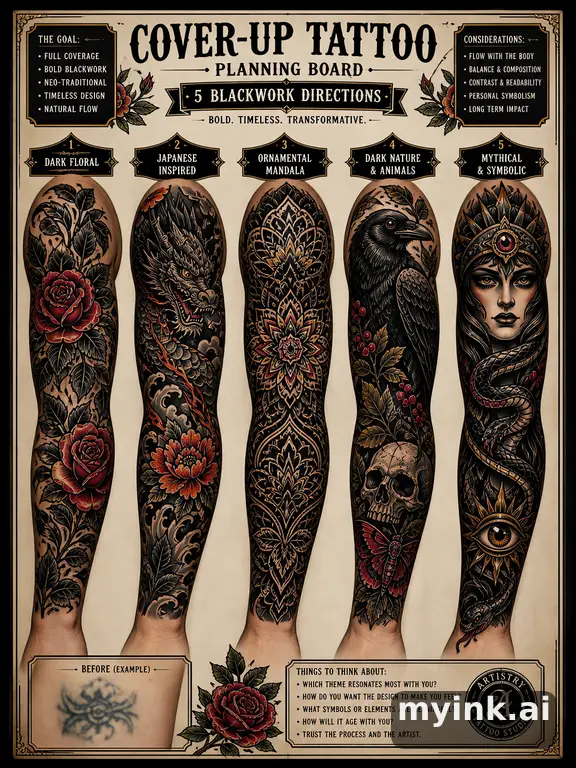
a cover-up tattoo planning board showing five blackwork directions, in neo-traditional tattoo style, bold outlines with detailed fills, vibrant colors, illustrative, professional tattoo photography
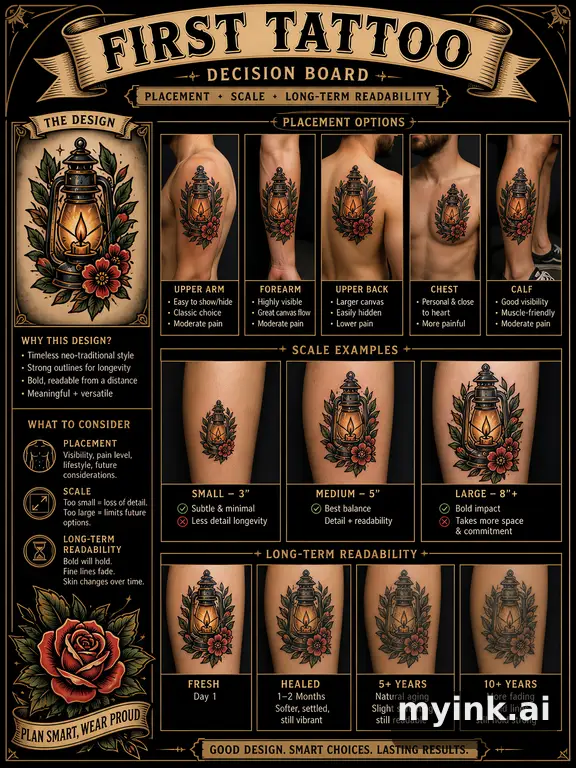
a first tattoo decision board comparing placement, scale, and long-term readability, in neo-traditional tattoo style, bold outlines with detailed fills, vibrant colors, illustrative, professional tattoo photography
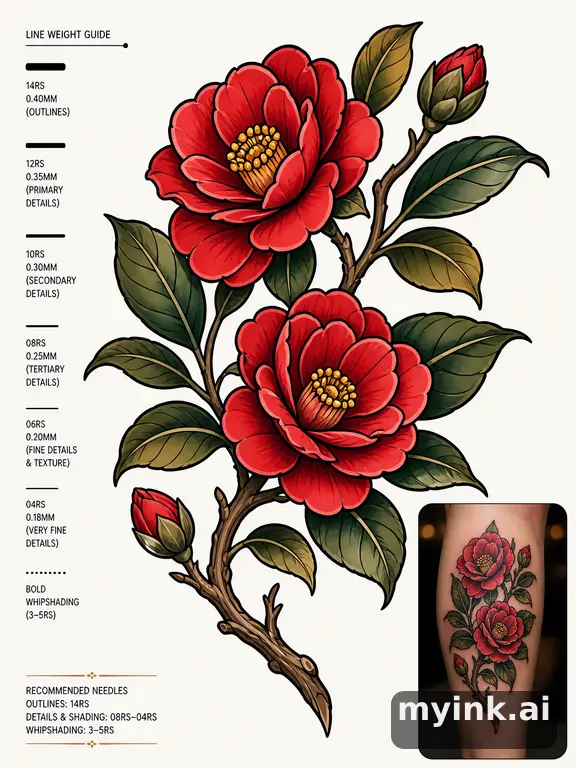
a clean stencil-ready botanical tattoo with line weight annotations, in neo-traditional tattoo style, bold outlines with detailed fills, vibrant colors, illustrative, professional tattoo photography
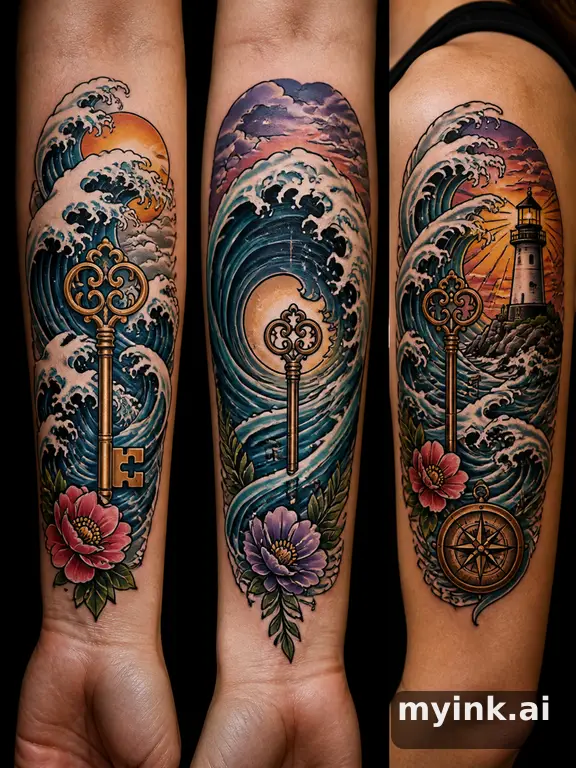
three symbolic memorial tattoo routes based on ocean waves and a small key, in neo-traditional tattoo style, bold outlines with detailed fills, vibrant colors, illustrative, professional tattoo photography
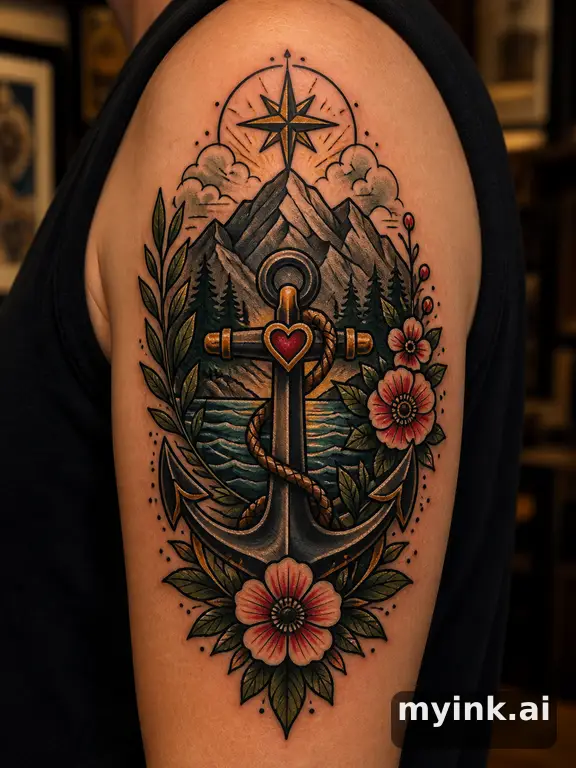
a meaningful vow tattoo concept with subtle symbols and aging-safe spacing, in neo-traditional tattoo style, bold outlines with detailed fills, vibrant colors, illustrative, professional tattoo photography
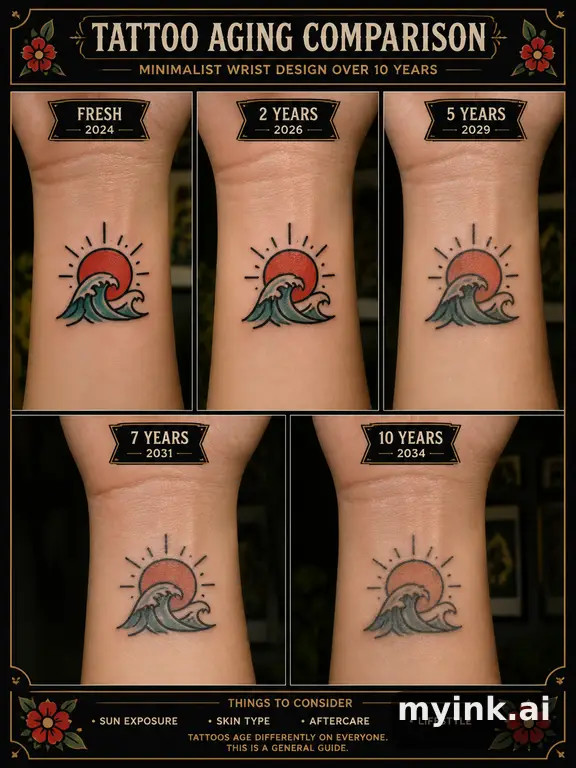
a tattoo aging comparison for a minimalist wrist design over ten years, in neo-traditional tattoo style, bold outlines with detailed fills, vibrant colors, illustrative, professional tattoo photography
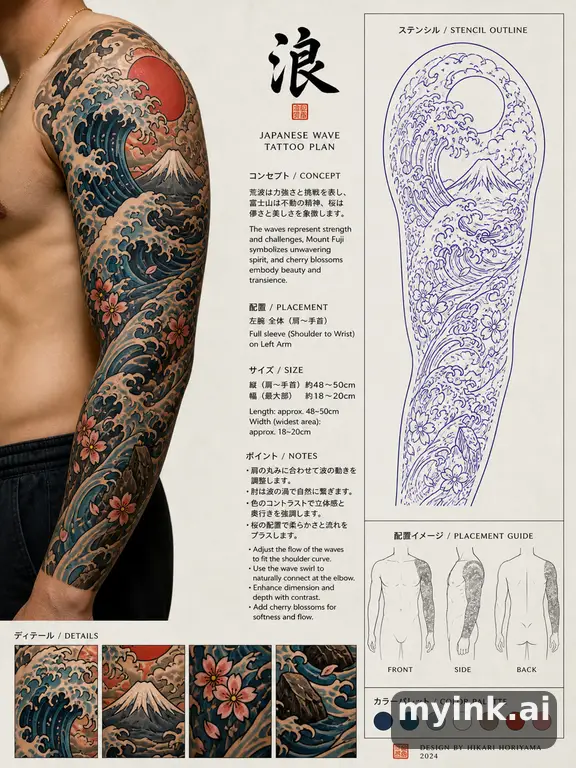
a consultation-ready Japanese wave tattoo plan with stencil and placement notes, in neo-traditional tattoo style, bold outlines with detailed fills, vibrant colors, illustrative, professional tattoo photography
Neo traditional tattooing grew directly out of the American Traditional revival and the art tattoo movement of the 1990s and 2000s, synthesizing influences from fine art, illustration, and tattoo history.
Neo traditional could not exist without American Traditional as its departure point. The bold outline system — the technical backbone of neo traditional — is inherited directly from traditional tattooing's century-old conventions. Neo traditional artists typically study traditional work deeply before expanding beyond it, understanding the rules they are choosing to break or bend.
Art Nouveau's organic forms, decorative frames, jeweled accents, and flowing botanical elements became central to neo traditional's visual vocabulary. Artists incorporated peacock feathers, ornate borders, geometric gem settings, and elongated figural proportions associated with Alphonse Mucha and the late 19th-century decorative arts movement. This art-historical literacy gives neo traditional unusual visual depth.
Many defining neo traditional artists came to tattooing from illustration, animation, or comic art backgrounds. Artists like Myke Chambers, Jime Litwalk, and Emily Rose Murray brought storytelling sensibilities and advanced color theory to the style. The resulting work often has a narrative quality — subjects exist in defined environments, respond to light sources, and display psychological expressiveness beyond flat icon imagery.
Neo traditional has developed a strong international following with dedicated conventions and publication platforms. Artists in Europe, North America, and Australia have built significant reputations and waitlists specifically within the style. Social media has allowed neo traditional work to reach global audiences, driving consistent demand growth for the style over the past decade.
Neo traditional designs are immediately identifiable by their bold structural outlines combined with expanded stylistic freedom in color, shading, and subject matter.
The signature technical element of neo traditional tattooing is the combination of heavy black outlines — structural and clear, as in American Traditional — with sophisticated interior shading that creates three-dimensional form. Where traditional work uses flat color fills, neo traditional builds tonal gradients, atmospheric depth, and surface texture within the same bold outline framework.
Neo traditional uses a dramatically wider color range than American Traditional, incorporating deep teals, purples, pinks, golds, and complex secondary mixes. Jewel tones — sapphire blue, emerald green, ruby red — are characteristic. Metallic effects, gem faceting, and decorative color are frequently incorporated into floral backgrounds, frames, and decorative elements surrounding the central subject.
Animal subjects in neo traditional style often display pronounced personality — a fox with knowing eyes, a raven with theatrical composure, an owl with regal ornamentation. The style allows for expressive exaggeration of features while maintaining anatomical plausibility, giving neo traditional animals a distinctive character quality that resonates strongly with collectors.
Elaborate floral frames, decorative borders, and Art Nouveau-inspired botanical surrounds are signature neo traditional compositional elements. A central subject — a portrait, animal, or object — is often framed by roses, peonies, leaves, and ornamental shapes arranged into a coherent decorative field. These frames simultaneously anchor the central subject and enrich the overall composition.
Neo traditional tattooing benefits from moderate to large scales where its dimensional shading and decorative detail can develop fully and remain legible.
The upper arm and bicep are ideal for neo traditional designs of medium format — an animal portrait surrounded by botanical framing, or a single decorative subject filling the bicep panel. The outer upper arm provides a flat, stable canvas that presents the design consistently from most viewing angles. This placement is popular for building toward a sleeve over time.
The forearm suits flowing neo traditional compositions that make full use of the style's decorative vocabulary — an animal subject surrounded by elaborate floral framing that extends along the forearm's length. Half sleeves from elbow to wrist or shoulder to elbow allow the style's full decorative potential to develop without requiring full-sleeve commitment from the outset.
The outer thigh provides generous canvas space for large-format neo traditional compositions that cannot develop their full decorative complexity in smaller areas. A detailed animal portrait with extensive floral surround, or a human figure study with Art Nouveau framing, requires the thigh's generous canvas to develop its intended visual richness.
Chest compositions — whether a single large centrepiece or a panel extending from the chest across the shoulder — suit neo traditional's tendency toward large, decorated subjects. The chest's relatively flat surface handles the style's dimensional shading well. Pain levels near the sternum and collarbone are higher, but the visual impact of a full neo traditional chest piece rewards the investment.
Explore roses rendered in neo traditional style with Art Nouveau framing and jeweled detail.
Discover neo traditional floral tattoos with bold outlines and dimensional color.
See butterflies rendered in neo traditional illustrative style with decorative wing detail.
Board-certified dermatologist guidance on safe tattooing practice, particularly relevant for complex color work like neo traditional designs.
Practical guide to the tattooing process including consultations, design planning, pain management, and aftercare for larger decorative tattoos.
Professional organization supporting safe tattooing practice, artist education, and studio hygiene standards across the industry.
Historical context for American Traditional tattooing, the foundational style from which neo traditional directly evolved.
Start with 8 free credits for one 4-preview design set. Preview the direction, then continue with credits only when it is worth exploring.
MyInk is most useful when the output is treated as a planning reference, not a finished tattoo appointment file. Start with the idea you want to test, choose a style that has a real tattoo tradition behind it, then review whether the design can survive on skin at the size and placement you have in mind.
A strong tattoo preview should have one clear subject, readable contrast, and enough negative space for the design to age. Tiny lettering, hairline detail, crowded symbols, soft watercolor edges, and low-contrast color combinations can look beautiful on screen while becoming hard to read after healing and years of sun exposure.
Placement changes the design. A forearm can carry vertical compositions and readable symbols. Ribs and chest placements need more attention to pain, breathing movement, and body curvature. Fingers, hands, and wrists fade faster because the skin moves, washes, and rubs more often. The preview should help you see those tradeoffs before you pay a deposit.
Use the generator to create directions, then narrow to one or two realistic options. Save the prompt, style, placement, and reference image. That record gives your artist a clearer starting point than a folder of unrelated screenshots and helps prevent last-minute design confusion at the consultation.
An artist still needs to redraw, resize, and adapt the concept. Tattooing is not the same as printing an image on skin. Line weight, stencil clarity, needle grouping, skin tone, body movement, and healing all affect the final result. Treat any AI image as a brief for discussion, not a file to copy without judgment.
Be especially careful with memorial, cultural, religious, medical, or partner-name tattoo ideas. Those designs carry meaning beyond aesthetics, so the right workflow includes a pause: check the spelling, symbolism, cultural context, and long-term emotional fit before turning a preview into a permanent mark.
If a page only gives you a pretty image, it has not answered the important question. A useful tattoo planning page should explain who the idea suits, where it works, what might age poorly, what to ask an artist, and when a safer variation would be smarter.
Before booking, compare the design at phone size, full screen, and roughly the real size on your body. If the main shape disappears when small, simplify it. If the design relies on fragile detail, make it larger or choose a bolder style. If the meaning feels unclear, revise the concept before you involve an artist.
Early tattoo ideation, style comparison, placement preview, cover-up exploration, memorial concept drafting, and preparing a clearer brief for an artist.
Copying another artist's work, replacing professional stencil preparation, guessing cultural meaning, or choosing a permanent tattoo from a single unreviewed image.
Check meaning, size, placement, contrast, aging risk, spelling, artist feasibility, and whether the design still feels right after a short waiting period.
Decide the role of the tattoo first. A decorative piece can be judged by visual strength, fit, and longevity. A memorial or symbolic piece needs a second layer of review: spelling, dates, cultural meaning, emotional timing, and whether the symbol will still feel right when the current life moment has changed.
Check the design at real size. A beautiful full-screen image can fail when reduced to a three-inch wrist tattoo. If the subject, lettering, or secondary symbols become hard to read at actual size, the concept needs fewer details, heavier line weight, more open spacing, or a larger placement.
Compare the style with the body area. Traditional, blackwork, and neo-traditional designs usually tolerate aging better because they use stronger outlines and contrast. Fine-line, watercolor, and tiny geometric pieces can be excellent, but they need careful artist selection, realistic sizing, and acceptance that touch-ups may be part of ownership.
If you are planning a cover-up, be even more conservative. A cover-up has to solve the old tattoo's darkness, shape, and location before it can become a new design. The AI preview can help explore directions, but a cover-up artist must judge what is possible on the existing skin.
Use try-on previews to test placement honestly. Rotate, scale, and compare the idea on the intended body part. A design that looks balanced on a flat screen may distort around elbows, ribs, wrists, shoulders, knees, or fingers. The goal is not a perfect simulation; the goal is catching obvious placement mistakes early.
Before sending anything to an artist, write a short brief: subject, style, placement, approximate size, meaning, colors to use or avoid, and any symbols that must stay out. Add one or two generated references, not twenty. A tight brief gives the artist space to create original work while preserving your intent.
Avoid treating a generated image as proof that a tattoo is safe, culturally appropriate, or technically ready. Ask a professional about stencil clarity, line weight, skin tone, placement movement, and healing. The better the AI-assisted planning, the easier that expert conversation becomes.
If the design still feels right after a short waiting period, the next step is a real consultation. If it stops feeling right, that is a useful result too. The safest tattoo planning workflow helps you avoid weak ideas as much as it helps you find strong ones.
A useful preview answers a specific decision question. On an aging page, the question is whether contrast and line weight will survive. On a meaning page, the question is whether the symbol says the right thing without becoming too crowded. On a cover-up page, the question is whether the new design can realistically hide the old shape. On a pack page, the question is whether the concept is ready for an artist handoff.
The best pages therefore combine image exploration with judgment. They explain what the design is good for, where it may fail, what to ask an artist, and which details should be simplified before the tattoo becomes permanent. This is the difference between browsing tattoo images and actually preparing for a safer appointment.
If the output feels close, do not keep generating randomly. Change one variable at a time: style, placement, size, subject, color, or amount of detail. Comparing focused variations helps you see which part of the idea is strong and which part is creating risk.
A tattoo preview should also make refusal easier. If the design looks wrong on the body, feels too tied to a temporary emotion, depends on detail that will not age, or needs a placement you are not comfortable wearing, stop there. Avoiding the wrong tattoo is a successful planning outcome.
Handoff examples should be judged by clarity. A useful example explains the concept, shows the chosen direction, gives the artist enough context, and leaves room for the artist to redraw instead of forcing a copied AI image. If the handoff would confuse a professional, the design is not ready yet.
Guide pages should help with the questions that sit around the image: what to prepare before a first tattoo, how to think about aftercare, when numbing cream needs artist approval, and how to avoid using pain or urgency as the only decision filter.
Sample handoff pages should be especially concrete. They need to show how a chosen direction supports an artist conversation, what still needs professional review, and when a user should keep refining the same Studio project.
When a page helps someone ask a better question before the needle touches skin, it has done real work for both searchers and future clients.
That is why the planning pages emphasize clear briefs, readable designs, realistic sizing, and artist review instead of treating image generation as the final step.
If a sample cannot explain that handoff clearly, it should be revised before publishing.
Clear handoffs reduce appointment friction.
They also reduce revision waste later.


