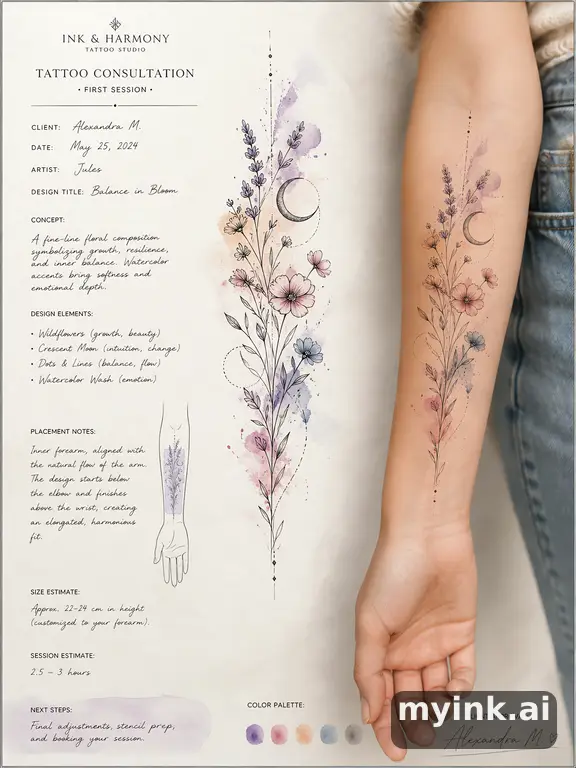
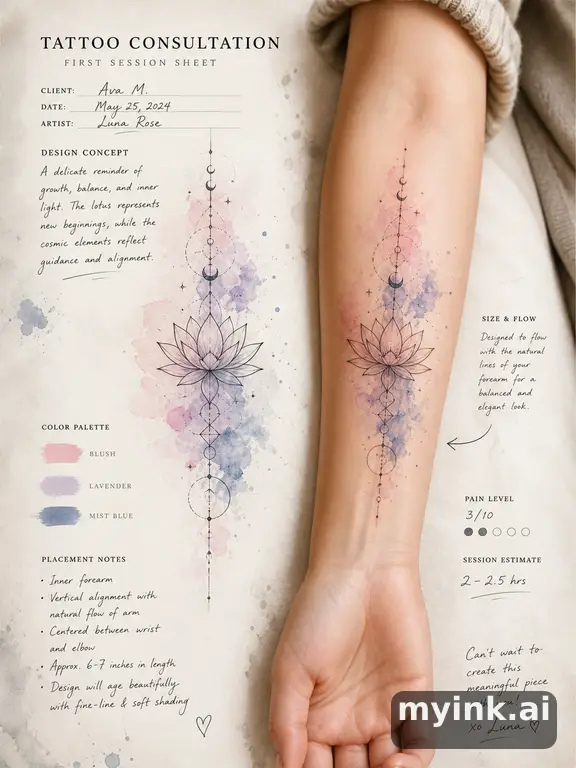
a consultation-ready Japanese wave tattoo plan with stencil and placement notes, in watercolor tattoo style, soft color splashes, painterly effect, blended edges, professional tattoo photography
Watercolor tattoo designs translate the luminous, spontaneous quality of watercolor painting into skin, creating tattoos that look like brushstrokes, color bleeds, and paint splashes rather than traditional ink work. The style emerged in the late 2000s as a reaction against the heavy outlines and solid fills of conventional tattooing, seeking instead the soft gradients, color diffusion, and apparent spontaneity associated with fine art on paper. At their best, watercolor tattoos appear to glow with internal light, their pigments seeming to float just beneath the skin's surface. Popular subjects include flowers, animals, birds, and abstract color fields, often presented without outlines so the colors themselves define form. The style demands exceptional color theory knowledge from the artist and careful placement on flatter body areas to prevent distortion. It also raises unique longevity questions that collectors should understand before committing. The MyInk AI generator offers a low-stakes way to explore watercolor palettes and compositions before the needle touches your skin.
Browse designs in this style, then jump into the generator when you are ready.
a consultation-ready Japanese wave tattoo plan with stencil and placement notes, in watercolor tattoo style, soft color splashes, painterly effect, blended edges, professional tattoo photography
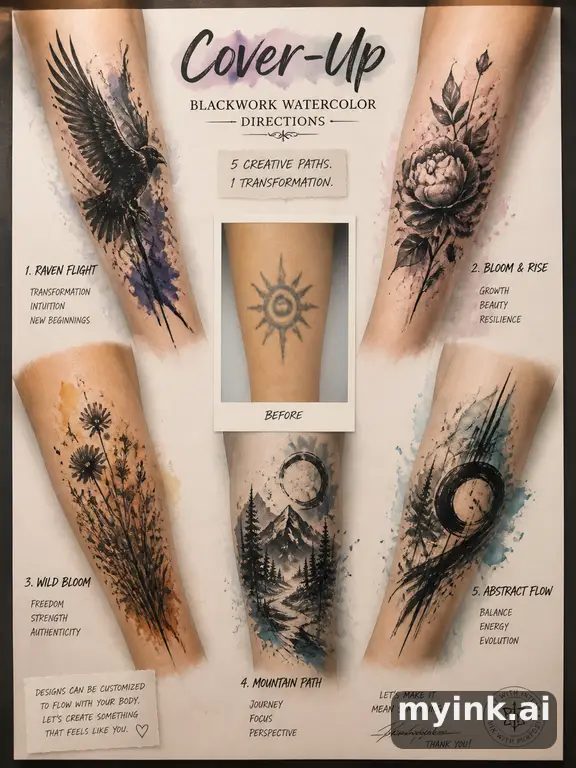
a cover-up tattoo planning board showing five blackwork directions, in watercolor tattoo style, soft color splashes, painterly effect, blended edges, professional tattoo photography
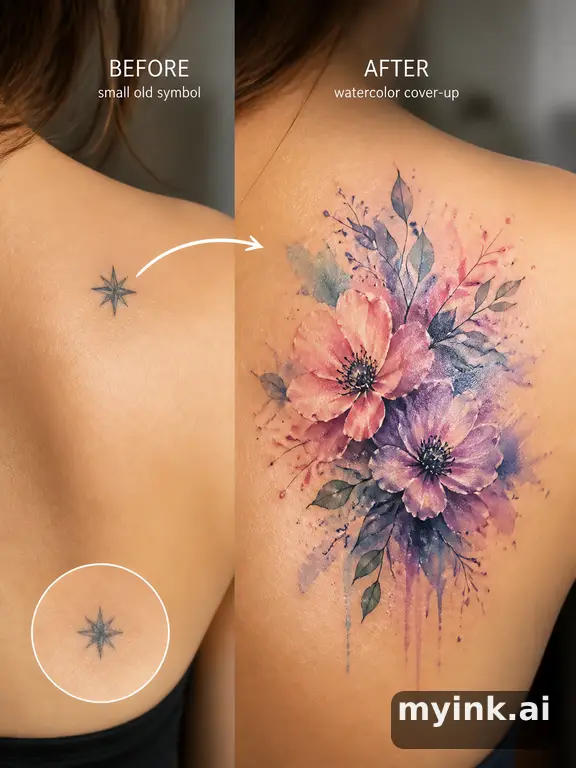
a before-and-after cover-up direction that absorbs an old small symbol, in watercolor tattoo style, soft color splashes, painterly effect, blended edges, professional tattoo photography
a sunrise over mountains, in watercolor tattoo style, soft color splashes, painterly effect, blended edges, professional tattoo photography
two hands pinky promise, in watercolor tattoo style, soft color splashes, painterly effect, blended edges, professional tattoo photography
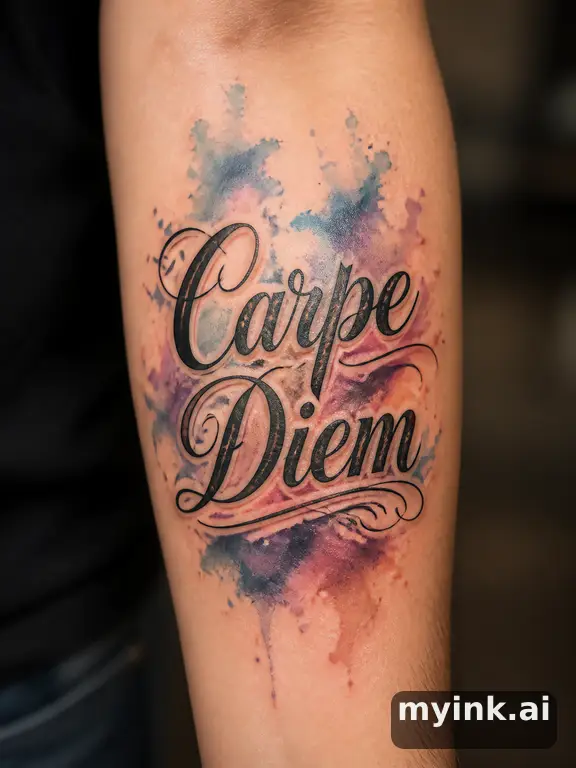
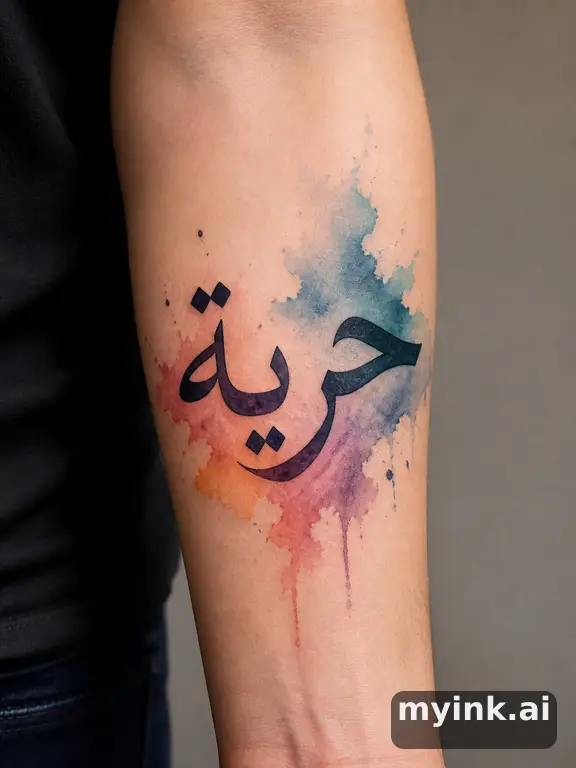
the Japanese kanji '武士道' (bushido), in watercolor tattoo style, soft color splashes, painterly effect, blended edges, professional tattoo photography
a before-and-after cover-up direction that absorbs an old small symbol, in watercolor tattoo style, soft color splashes, painterly effect, blended edges, professional tattoo photography
a first tattoo decision board comparing placement, scale, and long-term readability, in watercolor tattoo style, soft color splashes, painterly effect, blended edges, professional tattoo photography
Watercolor tattooing is one of the newest major styles in the industry, emerging from fine-art influences and technical advances in pigment formulation.
Watercolor tattooing emerged around 2007 to 2010 as artists with fine-art training began bringing painting techniques directly to skin. Amanda Wachob, a New York artist, is widely credited with pioneering the style by creating abstract color field compositions that referenced contemporary painting rather than traditional tattoo conventions. Her work demonstrated that tattooing could exist in the fine-art conversation.
Instagram accelerated watercolor tattooing's global spread dramatically between 2012 and 2016. The style's vivid colors photographed strikingly well, making watercolor pieces consistently viral on visual platforms. This visibility created both demand and a wave of artists attempting the style without adequate training, leading to quality variation that the market is still sorting through.
Watercolor effects in tattooing are achieved through careful dilution of ink, layered color passes, and precise needle pressure control. Artists must understand how different pigments interact under the skin — not all colors dilute predictably, and some bleed more aggressively than others. This technical knowledge comes only from extensive practice and differentiates skilled watercolor tattooers from imitators.
Many contemporary artists now use hybrid approaches — a solid black outline containing watercolor fills, or structural black brushstroke marks providing anchor points for looser color work. These hybrids address watercolor's longevity challenges while preserving its distinctive painterly aesthetic. The debate between outline and no-outline watercolor remains active in the tattoo community.
Watercolor tattooing has a distinctive visual grammar that separates it clearly from other styles, though it borrows technical elements from several traditions.
The defining visual elements of watercolor tattooing are loose, intentional color bleeds beyond the form's edge, paint drip effects running downward from subjects, and color splash backgrounds that suggest a brush loaded with pigment. These elements must be planned carefully — they appear spontaneous but require precise execution to avoid looking accidental.
Unlike traditional tattooing's flat fills, watercolor work builds form through multiple color passes that blend from saturated to diluted. A sunset sky effect in a watercolor landscape might require five or six separate color layers applied in sequence. This layering builds optical depth that mimics the translucency of actual watercolor paint on paper.
Flowers — particularly roses, poppies, and wildflower bouquets — are the most requested watercolor tattoo subjects because their organic forms suit the painterly treatment naturally. Hummingbirds, feathers, butterflies, and abstract geometric shapes are also popular. The best watercolor subjects have recognizable silhouettes even when their interior detail is soft or abstract.
The most avant-garde watercolor tattoos abandon representational subjects entirely, creating pure abstract color compositions — geometric color fields, overlapping transparent shapes, or gestural brushstroke marks. These pieces read as body-worn abstract paintings and appeal to collectors with fine-art backgrounds or those seeking something genuinely unusual.
Watercolor tattoos require more strategic placement decisions than most styles because their soft edges and light fills are most vulnerable to fading in high-movement areas.
The outer upper arm and shoulder provide relatively flat, stable skin that stretches minimally compared to joints. Watercolor designs here benefit from consistent healing and tend to retain their color saturation well. The upper arm is also easily concealed, making it a practical choice for those with workplace restrictions.
Large watercolor compositions — botanical bouquets, birds in flight, or abstract color fields — suit the thigh and ribcage due to their generous canvas space. The skin in these areas experiences relatively little daily abrasion, which helps soft watercolor edges maintain definition over time. Ribcage placement is more painful but provides a striking, easily hidden canvas.
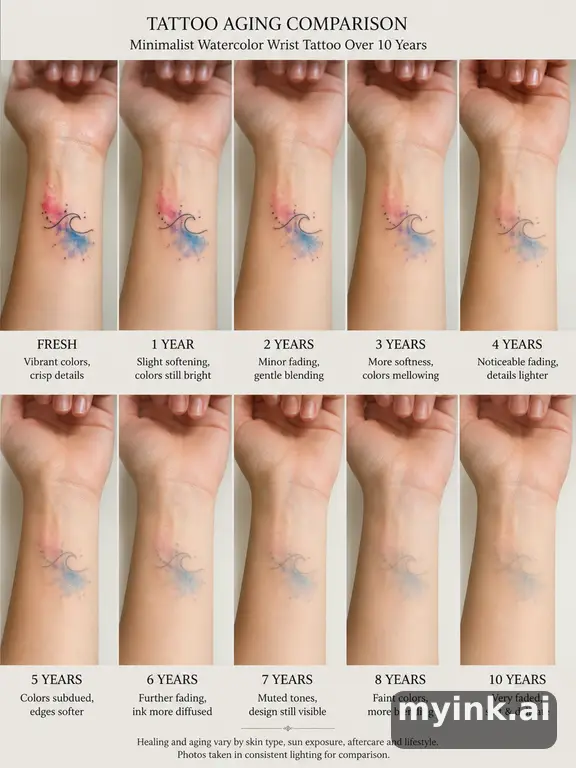
Wrists, elbows, knees, and finger placements are poor choices for watercolor tattoos. The skin in joint areas flexes constantly, which accelerates fading and causes soft ink deposits to migrate faster. Palms and feet are the worst possible placements for any watercolor work. Artists specializing in the style will advise against these locations.
UV exposure fades all tattoo colors, but watercolor tattoos — with their lighter, more diluted pigments — are particularly vulnerable. Consistent high-SPF sunscreen application on healed watercolor tattoos dramatically extends their vibrancy. Most watercolor artists recommend touch-ups every five to seven years to restore original color saturation.
Explore watercolor butterfly tattoos where wings become canvases for vivid color.
Discover watercolor flower tattoos blending botanical forms with painterly color.
See rose tattoos rendered in soft watercolor washes and color bleeds.
FDA guidance on tattoo ink composition, safety considerations, and the current regulatory status of tattoo pigments in the United States.
Step-by-step aftercare instructions and long-term color preservation strategies particularly relevant for delicate styles like watercolor.
Dermatologist-reviewed guidance on safe tattooing practices, allergic reaction risks, and ink pigment considerations.
Use our AI generator to create custom designs in seconds. Preview, customize, and download — completely free.
MyInk is most useful when the output is treated as a planning reference, not a finished tattoo appointment file. Start with the idea you want to test, choose a style that has a real tattoo tradition behind it, then review whether the design can survive on skin at the size and placement you have in mind.
A strong tattoo preview should have one clear subject, readable contrast, and enough negative space for the design to age. Tiny lettering, hairline detail, crowded symbols, soft watercolor edges, and low-contrast color combinations can look beautiful on screen while becoming hard to read after healing and years of sun exposure.
Placement changes the design. A forearm can carry vertical compositions and readable symbols. Ribs and chest placements need more attention to pain, breathing movement, and body curvature. Fingers, hands, and wrists fade faster because the skin moves, washes, and rubs more often. The preview should help you see those tradeoffs before you pay a deposit.
Use the generator to create directions, then narrow to one or two realistic options. Save the prompt, style, placement, and reference image. That record gives your artist a clearer starting point than a folder of unrelated screenshots and helps prevent last-minute design confusion at the consultation.
An artist still needs to redraw, resize, and adapt the concept. Tattooing is not the same as printing an image on skin. Line weight, stencil clarity, needle grouping, skin tone, body movement, and healing all affect the final result. Treat any AI image as a brief for discussion, not a file to copy without judgment.
Be especially careful with memorial, cultural, religious, medical, or partner-name tattoo ideas. Those designs carry meaning beyond aesthetics, so the right workflow includes a pause: check the spelling, symbolism, cultural context, and long-term emotional fit before turning a preview into a permanent mark.
If a page only gives you a pretty image, it has not answered the important question. A useful tattoo planning page should explain who the idea suits, where it works, what might age poorly, what to ask an artist, and when a safer variation would be smarter.
Before booking, compare the design at phone size, full screen, and roughly the real size on your body. If the main shape disappears when small, simplify it. If the design relies on fragile detail, make it larger or choose a bolder style. If the meaning feels unclear, revise the concept before you involve an artist.
Early tattoo ideation, style comparison, placement preview, cover-up exploration, memorial concept drafting, and preparing a clearer brief for an artist.
Copying another artist's work, replacing professional stencil preparation, guessing cultural meaning, or choosing a permanent tattoo from a single unreviewed image.
Check meaning, size, placement, contrast, aging risk, spelling, artist feasibility, and whether the design still feels right after a short waiting period.
Decide the role of the tattoo first. A decorative piece can be judged by visual strength, fit, and longevity. A memorial or symbolic piece needs a second layer of review: spelling, dates, cultural meaning, emotional timing, and whether the symbol will still feel right when the current life moment has changed.
Check the design at real size. A beautiful full-screen image can fail when reduced to a three-inch wrist tattoo. If the subject, lettering, or secondary symbols become hard to read at actual size, the concept needs fewer details, heavier line weight, more open spacing, or a larger placement.
Compare the style with the body area. Traditional, blackwork, and neo-traditional designs usually tolerate aging better because they use stronger outlines and contrast. Fine-line, watercolor, and tiny geometric pieces can be excellent, but they need careful artist selection, realistic sizing, and acceptance that touch-ups may be part of ownership.
If you are planning a cover-up, be even more conservative. A cover-up has to solve the old tattoo's darkness, shape, and location before it can become a new design. The AI preview can help explore directions, but a cover-up artist must judge what is possible on the existing skin.
Use try-on previews to test placement honestly. Rotate, scale, and compare the idea on the intended body part. A design that looks balanced on a flat screen may distort around elbows, ribs, wrists, shoulders, knees, or fingers. The goal is not a perfect simulation; the goal is catching obvious placement mistakes early.
Before sending anything to an artist, write a short brief: subject, style, placement, approximate size, meaning, colors to use or avoid, and any symbols that must stay out. Add one or two generated references, not twenty. A tight brief gives the artist space to create original work while preserving your intent.
Avoid treating a generated image as proof that a tattoo is safe, culturally appropriate, or technically ready. Ask a professional about stencil clarity, line weight, skin tone, placement movement, and healing. The better the AI-assisted planning, the easier that expert conversation becomes.
If the design still feels right after a short waiting period, the next step is a real consultation. If it stops feeling right, that is a useful result too. The safest tattoo planning workflow helps you avoid weak ideas as much as it helps you find strong ones.
A useful preview answers a specific decision question. On an aging page, the question is whether contrast and line weight will survive. On a meaning page, the question is whether the symbol says the right thing without becoming too crowded. On a cover-up page, the question is whether the new design can realistically hide the old shape. On a pack page, the question is whether the concept is ready for an artist handoff.
The best pages therefore combine image exploration with judgment. They explain what the design is good for, where it may fail, what to ask an artist, and which details should be simplified before the tattoo becomes permanent. This is the difference between browsing tattoo images and actually preparing for a safer appointment.
If the output feels close, do not keep generating randomly. Change one variable at a time: style, placement, size, subject, color, or amount of detail. Comparing focused variations helps you see which part of the idea is strong and which part is creating risk.
A tattoo preview should also make refusal easier. If the design looks wrong on the body, feels too tied to a temporary emotion, depends on detail that will not age, or needs a placement you are not comfortable wearing, stop there. Avoiding the wrong tattoo is a successful planning outcome.
Pack and sample pages should be judged by handoff quality. A useful pack explains the concept, shows the intended style, gives the artist enough context, and leaves room for the artist to redraw instead of forcing a copied AI image. If the handoff would confuse a professional, the design is not ready yet.
Guide pages should help with the questions that sit around the image: what to prepare before a first tattoo, how to think about aftercare, when numbing cream needs artist approval, and how to avoid using pain or urgency as the only decision filter.
Sample pack pages should be especially concrete. They need to show what the buyer receives, how the files support an appointment, what still needs artist review, and when a user should keep refining before purchasing a handoff pack.
When a page helps someone ask a better question before the needle touches skin, it has done real work for both searchers and future clients.
That is why the planning pages emphasize clear briefs, readable designs, realistic sizing, and artist review instead of treating image generation as the final step.
If a sample cannot explain that handoff clearly, it should be revised before purchase.
Clear handoffs reduce appointment friction.
They also reduce revision waste later.