Geometric Tattoo Designs — Precision, Pattern & Meaning

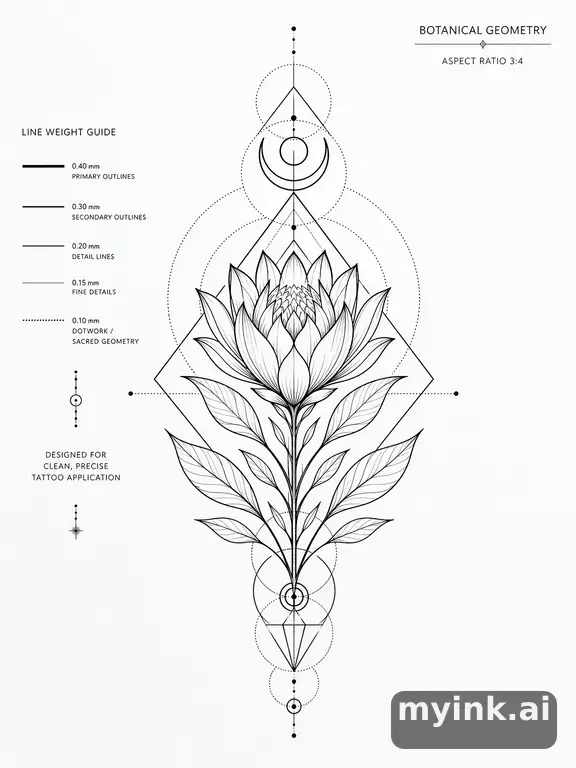
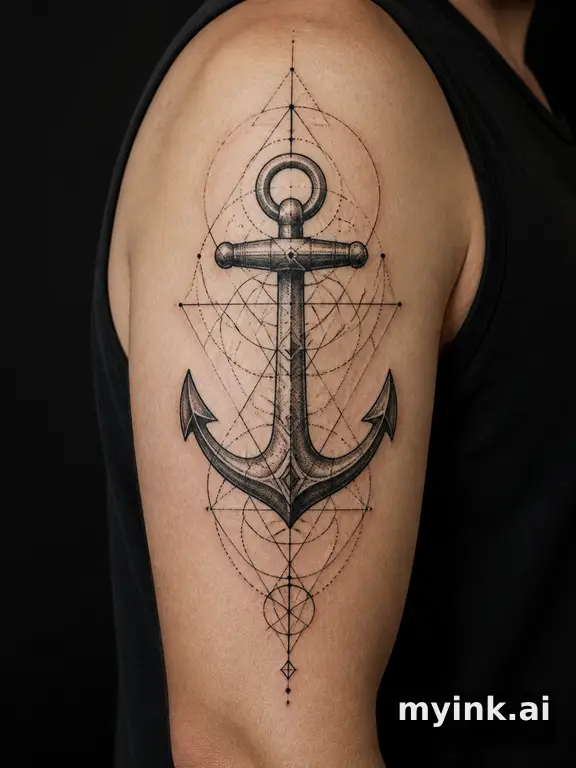
Geometric tattoo designs stand at the intersection of mathematics and art, transforming precise shapes, angles, and patterns into deeply personal body art. Defined by clean lines, symmetrical compositions, and often interlocking polygons, this style appeals to those who value both visual order and symbolic depth. Sacred geometry — pentagrams, Metatron's Cube, the Flower of Life — gives many geometric tattoos a spiritual dimension, while geometric renditions of animals and portraits offer a modern, abstract take on figurative subjects. The style emerged prominently in the 2010s alongside the rise of fine-line tattooing, though its roots trace back to ancient cultural motifs found on pottery, textiles, and architecture across civilizations. Today, geometric tattoos are among the most searched designs worldwide, requested by everyone from first-time clients to collectors building full sleeves. Use the MyInk AI generator to experiment with geometric arrangements before committing to the needle.

Generate a Geometric Tattoo

Recent Geometric Inspiration

Browse designs in this style, then jump into the generator when you are ready.

View All Inspiration

History and Origins of Geometric Tattooing

Geometric patterns in body art predate recorded history. What we recognize today as the geometric tattoo style is a synthesis of ancient symbolism and modern technical precision.

Ancient Roots in Global Culture

Geometric motifs appear in the tattoos of ancient Egypt, Polynesia, and pre-Columbian Mesoamerica. Otzi the Iceman, a 5,300-year-old mummy, bears simple geometric marks believed to have therapeutic or spiritual significance. These early examples show that humans have long used ordered shapes to inscribe meaning onto the body.

Sacred Geometry and Spiritual Symbolism

The revival of sacred geometry in contemporary tattooing draws from Pythagorean mathematics, Hermetic philosophy, and Eastern mandalas. Symbols like the Flower of Life, Fibonacci spirals, and Platonic solids carry layered meanings around creation, harmony, and cosmic order. Artists like Dr. Woo and Roxx helped bring these ideas into mainstream tattoo culture during the 2010s.

The Fine-Line and Neo-Geometric Movement

Advanced needles and machines in the 2010s allowed tattooers to achieve hairline precision previously impossible. This technical leap sparked the neo-geometric movement, where artists combined dotwork shading, negative space, and mathematically exact linework to create three-dimensional optical effects on flat skin.

Geometric Animals and Figurative Geometry

A particularly popular sub-genre places animals, portraits, or nature subjects inside or alongside geometric frames, polygons, or wireframe constructions. The contrast between organic subject matter and rigid geometry creates a visually striking tension that remains one of the most requested tattoo concepts today.

Key Characteristics and Popular Geometric Designs

Understanding what defines the geometric style helps you communicate clearly with your artist and use AI generation tools more effectively.

Linework, Symmetry, and Precision

The hallmark of geometric tattooing is clean, consistent linework executed with mathematical symmetry. Artists use compasses, rulers, and digital planning tools to map compositions before touching skin. Even a single misaligned line can disrupt the optical harmony of the design, making geometric work some of the most technically demanding in tattooing.

Mandalas and Radial Patterns

Mandalas are among the most requested geometric tattoo ideas, featuring concentric circles and repeating motifs that radiate from a central point. They work beautifully on round body surfaces like the shoulder, knee, or upper back. Dotwork shading within mandala petals adds depth without color, keeping the overall palette restrained.

Negative Space and Optical Illusions

Skilled geometric tattooers exploit the contrast between inked skin and bare skin to create shapes that appear three-dimensional. Cubes, tunnels, and Penrose triangles rendered in geometric style play with perception in ways few other tattoo genres can match. The untattooed skin becomes as important as the ink itself.

Color Accents in Geometric Work

While many geometric tattoos rely on black ink alone, strategic color accents — watercolor washes inside polygons, single-color fills in selected segments — can elevate the design dramatically. Limiting the palette to one or two hues maintains the clean, precise aesthetic that defines the style.

Best Placements and Sizing for Geometric Tattoos

Placement is especially critical in geometric tattooing because symmetry and flat canvas space determine how well a design reads on the body.

Chest and Sternum for Center Symmetry

The sternum and chest offer a naturally symmetrical plane, making them ideal for mandala-based or bilaterally mirrored geometric designs. Large centerpiece compositions that extend toward the shoulders and collarbones can unify multiple geometric elements into a cohesive whole. Expect moderate pain levels in this area.

Forearm and Sleeve Geometry

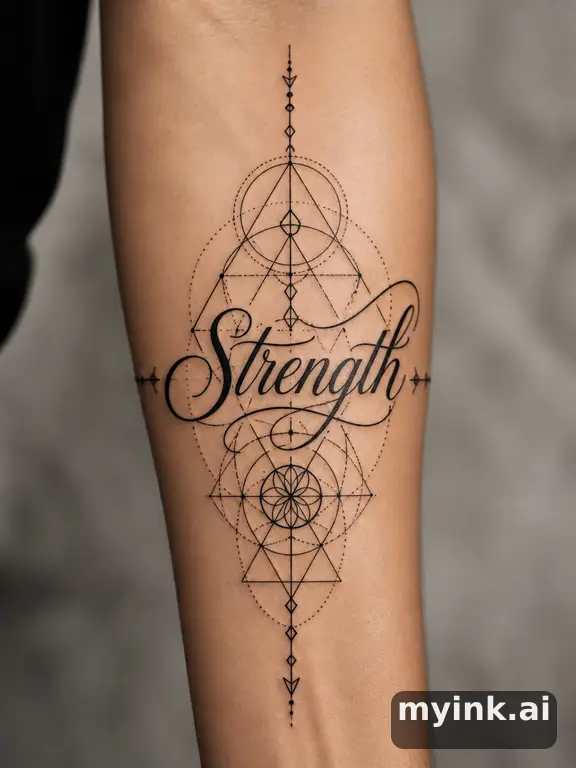
The forearm's long, relatively flat surface suits flowing geometric sleeve designs that incorporate multiple shapes, animals, or sacred symbols connected by linework. Full geometric sleeves can take multiple sessions spanning months but reward patience with stunning visual impact. The outer forearm is lower in pain than the inner.

Back and Shoulder Blade Panels

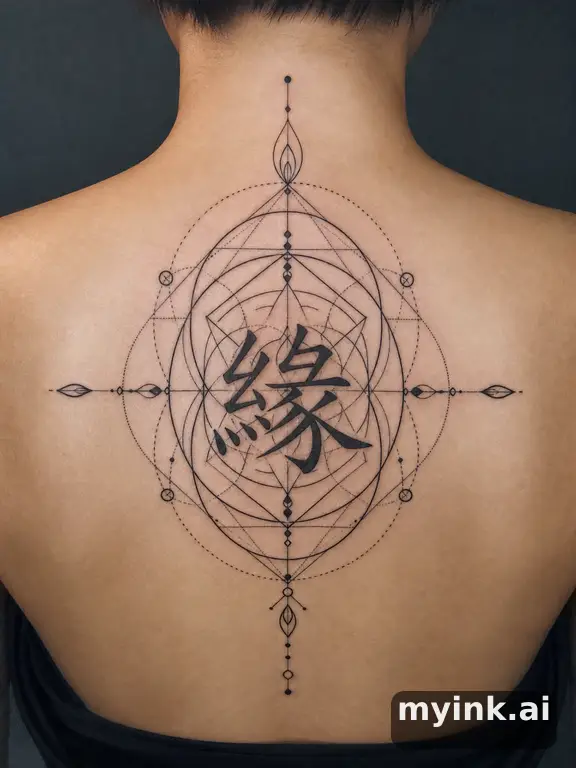
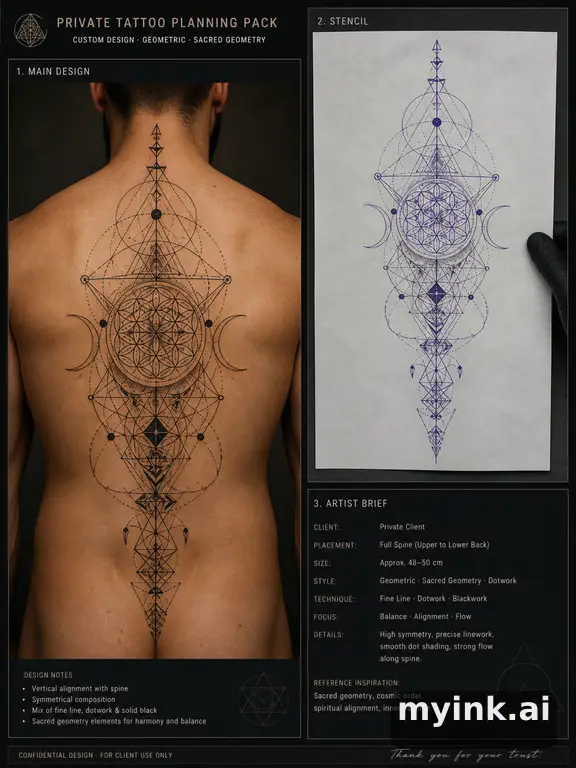
The upper back offers the largest flat canvas on the human body, allowing for complex geometric compositions — full mandala back pieces, geometric landscapes, or sacred geometry grids — that would be impossible elsewhere. Shoulder blades frame two symmetrical panels that work well as matching or complementary geometric designs.

Small Geometric Pieces on Wrist and Ankle

Minimalist geometric tattoos — a single triangle, hexagon, or sacred symbol — scale down beautifully to the wrist, ankle, or behind the ear. At small sizes, lines must be especially clean because there is no surrounding detail to mask imprecision. Fine-line artists specializing in geometric work are the best choice for small placements.

Frequently Asked Questions

How long do geometric tattoos take to complete?
A small, simple geometric design might take one to two hours, while a complex mandala or geometric sleeve can require multiple sessions of four to six hours each. Intricate linework demands rest breaks to maintain artist precision, so rushing the process often compromises quality.
Do geometric tattoos age well over time?
Clean black linework in the geometric style ages better than color or soft-shaded tattoos because the lines remain distinct even as ink spreads slightly over decades. Choosing an experienced artist who understands line weight is the single biggest factor in long-term quality.
What is the difference between geometric and dotwork tattoos?
Geometric tattoos use continuous lines to define shapes and structures, while dotwork creates shading and form through thousands of individual dots. Many geometric tattoos incorporate dotwork shading within their shapes, making the two styles complementary rather than mutually exclusive.
Are sacred geometry tattoos culturally appropriative?
Sacred geometry draws from mathematical and philosophical traditions that span multiple cultures globally, and most symbols like the Flower of Life or Fibonacci spiral are considered universal rather than belonging to one specific group. Symbols with specific religious or ethnic origins — like Maori koru patterns — merit more careful consideration and ideally consultation with someone from that tradition.
Can I customize a geometric tattoo to include my own symbols?
Absolutely — geometric tattooing is highly adaptable. Initials, birthdates, or personally significant shapes can be incorporated into geometric frameworks by a skilled designer. AI tattoo generators like MyInk make it easy to sketch out personalized geometric concepts before your studio consultation.

Ready to Design Your Geometric Tattoo?

Use our AI generator to create custom designs in seconds. Preview, customize, and download — completely free.

How to Use an AI Tattoo Preview Before You Book

MyInk is most useful when the output is treated as a planning reference, not a finished tattoo appointment file. Start with the idea you want to test, choose a style that has a real tattoo tradition behind it, then review whether the design can survive on skin at the size and placement you have in mind.

A strong tattoo preview should have one clear subject, readable contrast, and enough negative space for the design to age. Tiny lettering, hairline detail, crowded symbols, soft watercolor edges, and low-contrast color combinations can look beautiful on screen while becoming hard to read after healing and years of sun exposure.

Placement changes the design. A forearm can carry vertical compositions and readable symbols. Ribs and chest placements need more attention to pain, breathing movement, and body curvature. Fingers, hands, and wrists fade faster because the skin moves, washes, and rubs more often. The preview should help you see those tradeoffs before you pay a deposit.

Use the generator to create directions, then narrow to one or two realistic options. Save the prompt, style, placement, and reference image. That record gives your artist a clearer starting point than a folder of unrelated screenshots and helps prevent last-minute design confusion at the consultation.

An artist still needs to redraw, resize, and adapt the concept. Tattooing is not the same as printing an image on skin. Line weight, stencil clarity, needle grouping, skin tone, body movement, and healing all affect the final result. Treat any AI image as a brief for discussion, not a file to copy without judgment.

Be especially careful with memorial, cultural, religious, medical, or partner-name tattoo ideas. Those designs carry meaning beyond aesthetics, so the right workflow includes a pause: check the spelling, symbolism, cultural context, and long-term emotional fit before turning a preview into a permanent mark.

If a page only gives you a pretty image, it has not answered the important question. A useful tattoo planning page should explain who the idea suits, where it works, what might age poorly, what to ask an artist, and when a safer variation would be smarter.

Before booking, compare the design at phone size, full screen, and roughly the real size on your body. If the main shape disappears when small, simplify it. If the design relies on fragile detail, make it larger or choose a bolder style. If the meaning feels unclear, revise the concept before you involve an artist.

Best fit

Early tattoo ideation, style comparison, placement preview, cover-up exploration, memorial concept drafting, and preparing a clearer brief for an artist.

Poor fit

Copying another artist's work, replacing professional stencil preparation, guessing cultural meaning, or choosing a permanent tattoo from a single unreviewed image.

Before using

Check meaning, size, placement, contrast, aging risk, spelling, artist feasibility, and whether the design still feels right after a short waiting period.

Tattoo Planning Checklist

Decide the role of the tattoo first. A decorative piece can be judged by visual strength, fit, and longevity. A memorial or symbolic piece needs a second layer of review: spelling, dates, cultural meaning, emotional timing, and whether the symbol will still feel right when the current life moment has changed.

Check the design at real size. A beautiful full-screen image can fail when reduced to a three-inch wrist tattoo. If the subject, lettering, or secondary symbols become hard to read at actual size, the concept needs fewer details, heavier line weight, more open spacing, or a larger placement.

Compare the style with the body area. Traditional, blackwork, and neo-traditional designs usually tolerate aging better because they use stronger outlines and contrast. Fine-line, watercolor, and tiny geometric pieces can be excellent, but they need careful artist selection, realistic sizing, and acceptance that touch-ups may be part of ownership.

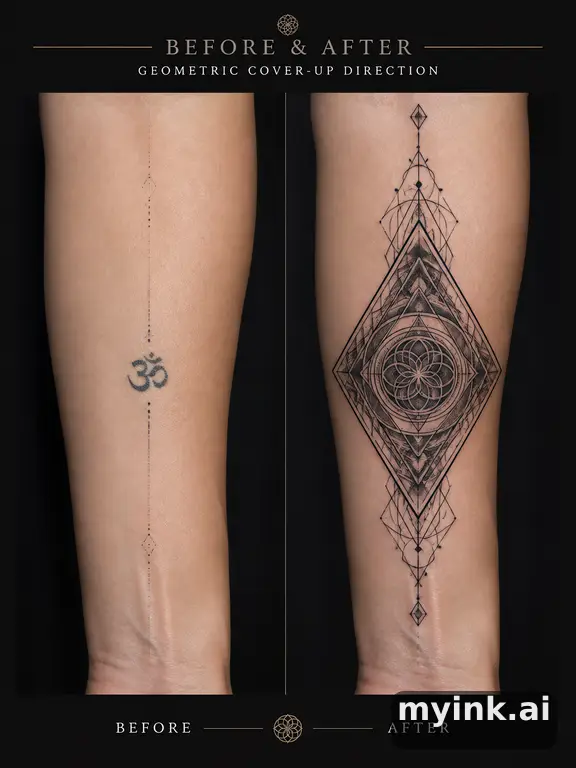
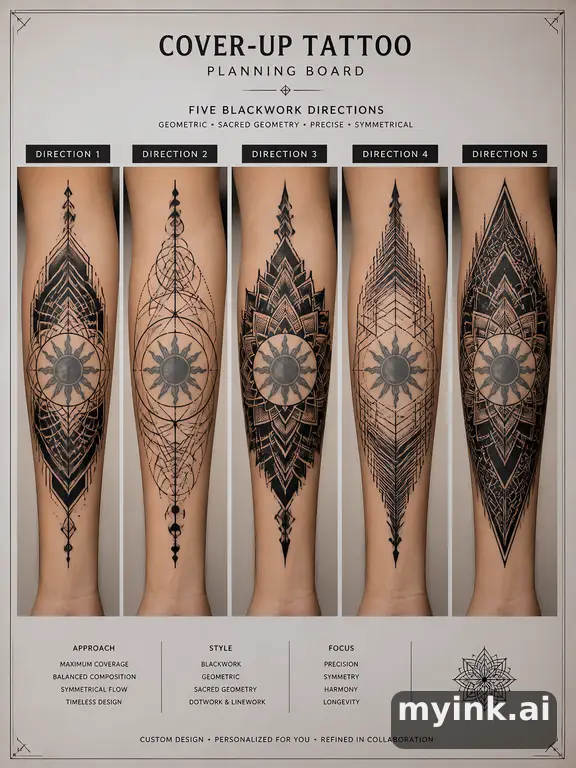
If you are planning a cover-up, be even more conservative. A cover-up has to solve the old tattoo's darkness, shape, and location before it can become a new design. The AI preview can help explore directions, but a cover-up artist must judge what is possible on the existing skin.

Use try-on previews to test placement honestly. Rotate, scale, and compare the idea on the intended body part. A design that looks balanced on a flat screen may distort around elbows, ribs, wrists, shoulders, knees, or fingers. The goal is not a perfect simulation; the goal is catching obvious placement mistakes early.

Before sending anything to an artist, write a short brief: subject, style, placement, approximate size, meaning, colors to use or avoid, and any symbols that must stay out. Add one or two generated references, not twenty. A tight brief gives the artist space to create original work while preserving your intent.

Avoid treating a generated image as proof that a tattoo is safe, culturally appropriate, or technically ready. Ask a professional about stencil clarity, line weight, skin tone, placement movement, and healing. The better the AI-assisted planning, the easier that expert conversation becomes.

If the design still feels right after a short waiting period, the next step is a real consultation. If it stops feeling right, that is a useful result too. The safest tattoo planning workflow helps you avoid weak ideas as much as it helps you find strong ones.

What Makes a Preview Useful

A useful preview answers a specific decision question. On an aging page, the question is whether contrast and line weight will survive. On a meaning page, the question is whether the symbol says the right thing without becoming too crowded. On a cover-up page, the question is whether the new design can realistically hide the old shape. On a pack page, the question is whether the concept is ready for an artist handoff.

The best pages therefore combine image exploration with judgment. They explain what the design is good for, where it may fail, what to ask an artist, and which details should be simplified before the tattoo becomes permanent. This is the difference between browsing tattoo images and actually preparing for a safer appointment.

If the output feels close, do not keep generating randomly. Change one variable at a time: style, placement, size, subject, color, or amount of detail. Comparing focused variations helps you see which part of the idea is strong and which part is creating risk.

A tattoo preview should also make refusal easier. If the design looks wrong on the body, feels too tied to a temporary emotion, depends on detail that will not age, or needs a placement you are not comfortable wearing, stop there. Avoiding the wrong tattoo is a successful planning outcome.

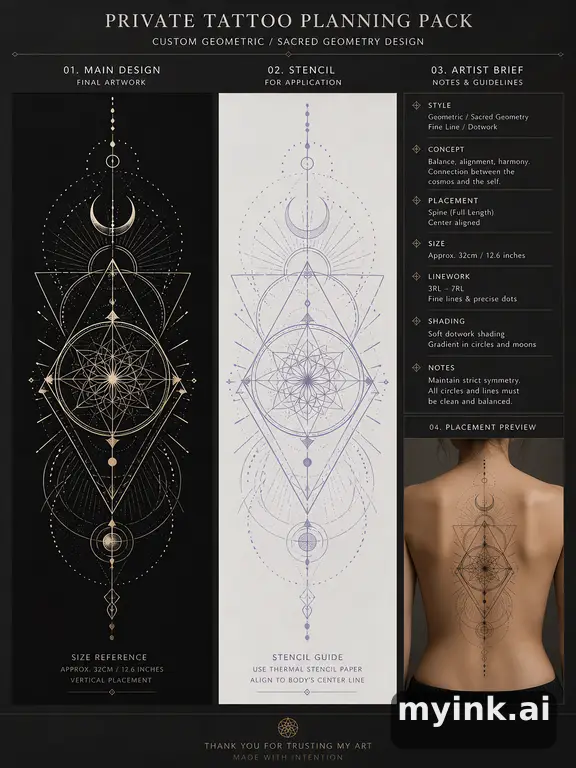
Pack and sample pages should be judged by handoff quality. A useful pack explains the concept, shows the intended style, gives the artist enough context, and leaves room for the artist to redraw instead of forcing a copied AI image. If the handoff would confuse a professional, the design is not ready yet.

Guide pages should help with the questions that sit around the image: what to prepare before a first tattoo, how to think about aftercare, when numbing cream needs artist approval, and how to avoid using pain or urgency as the only decision filter.

Sample pack pages should be especially concrete. They need to show what the buyer receives, how the files support an appointment, what still needs artist review, and when a user should keep refining before purchasing a handoff pack.

When a page helps someone ask a better question before the needle touches skin, it has done real work for both searchers and future clients.

That is why the planning pages emphasize clear briefs, readable designs, realistic sizing, and artist review instead of treating image generation as the final step.

If a sample cannot explain that handoff clearly, it should be revised before purchase.

Clear handoffs reduce appointment friction.

They also reduce revision waste later.