Lionel Messi Tattoos: Meanings & Design Analysis
Lionel Messi’s tattoos invite a design reading through family, faith, and football themes. This article looks at composition, placement, line weight, and negative space while distinguishing reported tattoo details from interpretation. It does not establish a complete tattoo count or claim to know his reasons for every piece. His official Inter Miami profile records his birth date as 24 June 1987; an unexplained number in a tattoo should not be treated as biographical evidence.
About the evidence. Official sources below support the biographical details specifically attributed to them. Tattoo locations and motifs are attributed to named reporting; design readings are editorial interpretations, not statements from Messi. The illustrations are interpretive MyInk renderings, not photographs or an exact record of his tattoos.
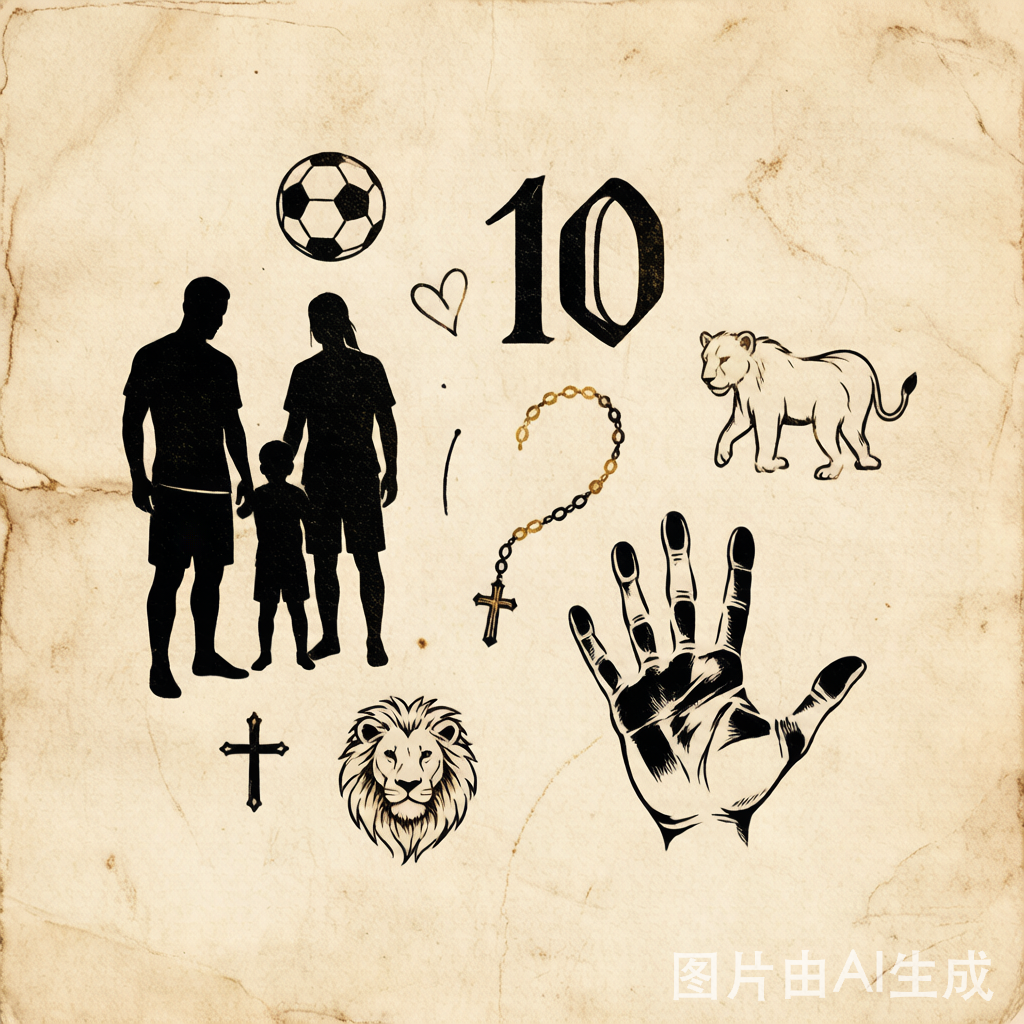
The Player Snapshot
| Subject | Lionel Messi (Argentina, No. 10) |
| Scope | Selected reported motifs; not a complete tattoo census |
| Dominant themes | Family · Faith · Football · Personal milestones |
| Prominent compositions | Right arm sleeve and left-leg blackwork |
| Design focus | How repeated motifs and open space can connect a collection |
The Tattoo Inventory (by Theme)
1. Family — the backbone of the collection
Family is a useful lens for this collection. On his official biography page, Messi describes how becoming a father changed his perspective and how he values time with his family. That supports the biographical context, not a specific meaning for every tattoo. The USA TODAY report republished by Yahoo Sports describes these family motifs:
- His sons’ names and birthdates — Thiago, Mateo, and Ciro — above his right ankle, according to that report.
- Thiago’s handprints on his left lower leg.
- His mother Celia’s portrait on his left shoulder blade.
2. Faith — Catholic iconography
The same USA TODAY report identifies Jesus wearing a crown of thorns near the top of Messi’s right-arm sleeve and rosary beads among its motifs. These can be read as Christian imagery; that visual reading does not establish his upbringing or the personal meaning he assigns to each element.
3. Football — the profession made permanent
- The No. 10 and football on the left leg are identified in the USA TODAY report and provide a direct visual connection to the sport.
- No reliable explanation of “MAS 91” is established by the sources used here. It should not be decoded as his birth year: his official Inter Miami profile records 1987. No substitute symbolic meaning is assigned here.
4. Personal milestones
Small symbols can connect a growing sleeve visually, but a motif alone does not date an event or explain its meaning. This section treats the idea of a sleeve as a timeline as a design interpretation, rather than a verified chronology of Messi’s life.
Meaning & Cultural Analysis
Three design readings are useful here, without claiming access to Messi’s private intentions:
- Tribute as identity. A name or handprint can make family the focus of a composition. That is a way to read the reported motifs, not evidence about sponsorship or his motives.
- Religious visual language. A rosary or Christ image can carry Christian associations. Its personal significance needs the wearer’s own explanation; it cannot stand for what all Argentine people believe.
- The sleeve as a timeline. Connected pieces can be read as chapters in a collection, but their positions do not prove the order in which they were added.
For your own tribute, compare a shared line weight, palette, or negative-space rhythm before deciding which elements belong together. These are design choices to discuss with an artist, not a formula for reproducing another person’s story.
Design Breakdown (Original MyInk Diagram)
The MyInk illustration below explores how a family tribute concept can be structured as one composition. It is a design study, not a diagram of Messi’s actual tattoo or a claim of hands-on tattooing experience.
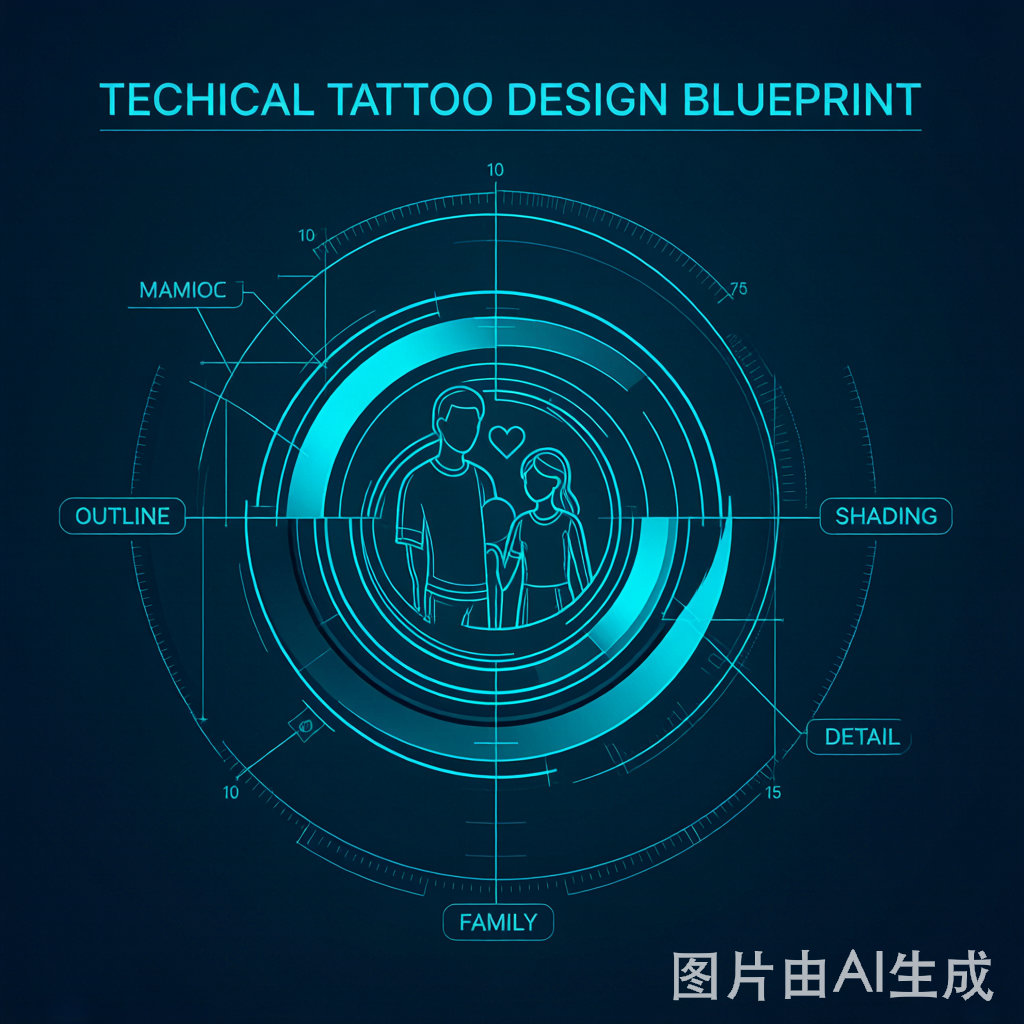
A well-built tribute, layer by layer:
- Outer outline — establishes the silhouette. Compare bold and fine outlines according to the scale and mood you want.
- Midtone shading — gives the handprint or portrait dimension without muddying.
- Fine-line detailing — birthdates, names. This is where legibility lives or dies.
- Negative-space focal point — the deliberate un-inked area that makes the eye land on the subject.
Design observation: In this illustration, open space separates the focal motif from the surrounding detail. Compare that spacing with a denser version before choosing a direction.
Placement Map & Three-View Logic
The reported locations can be compared as a composition:
- Right arm: a sleeve containing religious and other imagery.
- Right lower leg, above the ankle: the reported sons’ names and dates.
- Left lower leg: the handprint and football motifs.
- Left shoulder blade: the reported portrait of his mother.
The USA TODAY report supports these locations, not claims that Messi chose one area for privacy or another for public display. For a three-view study of your own design, compare front, side, and back views, then ask an artist to assess placement on your body. A preview cannot establish personal pain levels or exact physical fit.
Time & Pain Analysis
The sources used here do not establish Messi’s session counts or pain ratings. A photograph cannot supply either. For planning your own piece, use questions rather than treating estimated numbers as his experience:
| Area or format | Planning question |
|---|---|
| Arm sleeve | How will the artist divide the composition and sessions? |
| Lower leg / ankle | What size and detail will remain readable around this contour? |
| Calf | How does the motif change between standing and moving? |
| Shoulder-blade portrait | How much space does the face need, and how will it connect to nearby work? |
Ask the artist about the likely schedule for your actual design. Individual discomfort and healing vary; this article does not reconstruct Messi’s appointments or give a personal pain prediction.
MyInk Editorial: What Makes a Tribute “Good”
A tribute can be planned as a connected collection rather than a series of unrelated additions. The following are editorial suggestions for your own design, not findings from studio clients or a reconstruction of Messi’s artists:
- Group related motifs. Decide which names or symbols should be read together, while leaving room for future additions.
- Choose a visual thread. Compare a repeated line weight or palette across the pieces; visual consistency alone cannot identify who tattooed them.
- Set a focal point. A portrait, handprint, or number can lead the composition. Decide what should remain secondary rather than assuming every gap needs a new symbol.
Start with a single constraint — one style or one palette — and discuss the collection with your artist. The MyInk idea-planning entry can help frame the concept before that conversation; it does not predict how the finished tattoo will age.
Design Your Own
Use these themes as a starting point for your own story. Choose a focal motif, decide what it means to you, and compare how much open space it needs before asking an artist to develop the final design.
- Sketch a family or milestone concept with our AI Tattoo Generator.
- See how a portrait or handprint reads on your own body with Virtual Try-On.
- Study the symbolism behind common choices in our Tattoo Meanings guide.
- Compare styles — from Minimalist to Realistic — before committing line weight.
Sources
- Inter Miami CF — Leo Messi player profile: official birth date, birthplace, and player details.
- Leo Messi — official biography: his own account of family and football, not a tattoo inventory.
- FIFA — Messi’s remarkable rollercoaster year (23 December 2016): records the blacking out of his left-leg tattoos, without explaining every symbol.
- Meghan L. Hall, USA TODAY — Lionel Messi’s tattoos: Deciphering the meaning of his famous ink (16 June 2026, republished by Yahoo Sports): secondary reporting on the selected motifs and locations described above.
This is a selection of reported tattoo details and editorial design commentary, not a complete inventory or a record of Messi’s personal explanations. The MyInk images remain interpretive illustrations rather than photographs of his body.
Explore More
- Ready to design a tribute that ages well? Try our AI Tattoo Generator to explore a draft concept. Processing time varies between requests.
- See it on your own skin first with Virtual Try-On.
- Browse the Tattoo Meaning Guide for symbol breakdowns.
- New to ink? Start with our First Tattoo Guide.